The rapid expansion of electric vehicles has transformed manufacturing standards across the automotive industry. Unlike conventional vehicles, EVs rely heavily on high-voltage battery systems, compact power electronics, lightweight materials, and advanced thermal management assemblies. These components require extremely precise quality control because even small internal defects can affect safety, performance, and battery lifespan.
This is where industrial CT scanning has become essential for modern e-mobility inspection workflows.
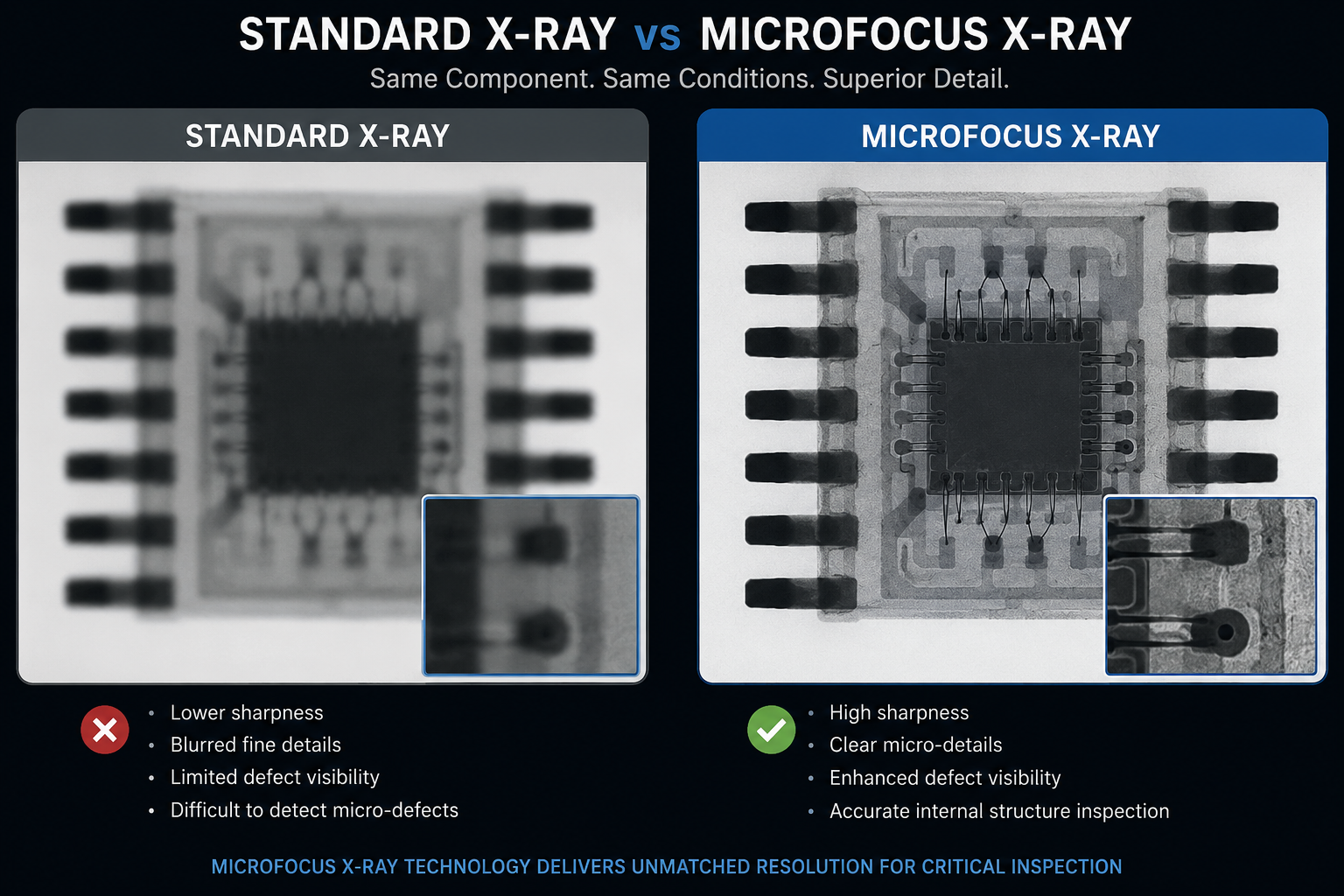
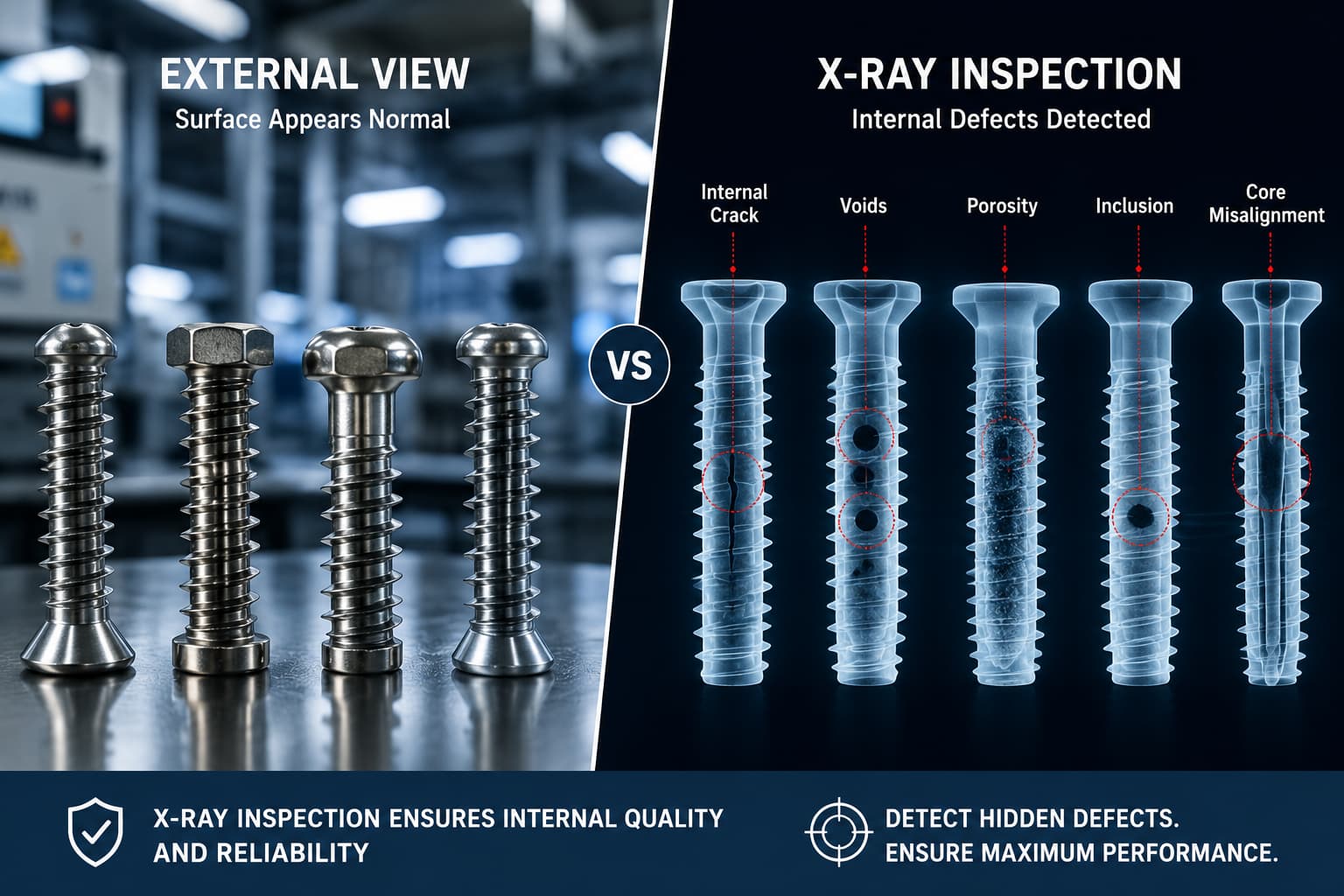
Unlike traditional inspection methods that only evaluate external surfaces, industrial computed tomography (CT) allows manufacturers to inspect the internal structure of EV components without destroying them. Hidden cracks, voids, porosity, misalignments, weld defects, and assembly issues can be detected early in production before they become costly failures.
For manufacturers scaling EV production, CT inspection is no longer limited to R&D labs. It is increasingly integrated into production environments through AI-driven inline CT systems and automated defect recognition.
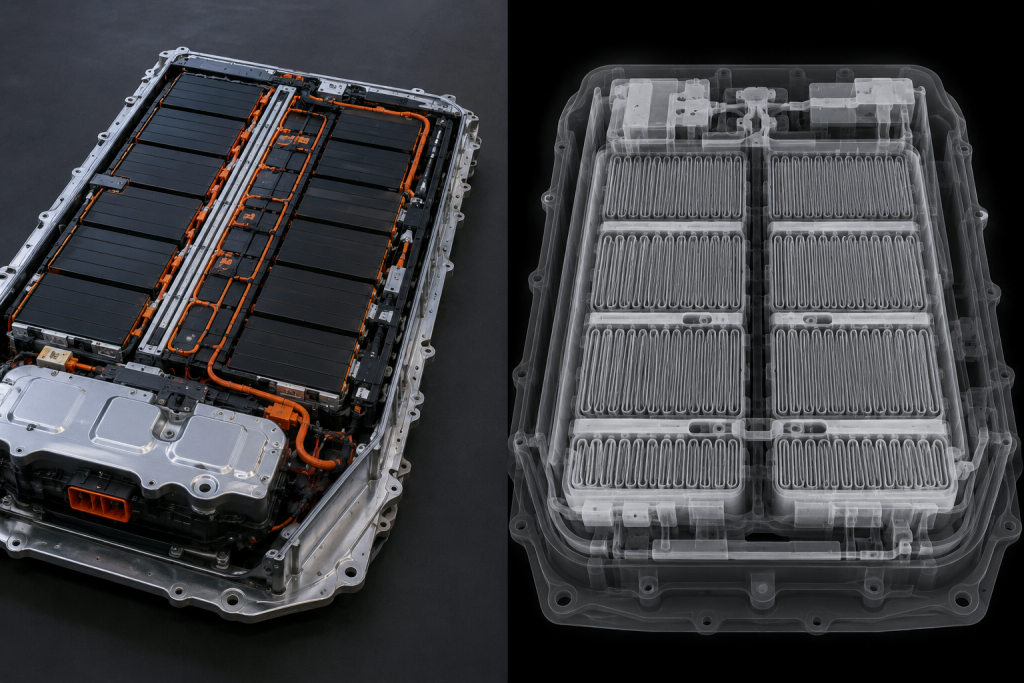
Industrial CT Scanning of EV Battery Pack
Why E-Mobility Manufacturers Need Industrial CT Scanning
Electric vehicle manufacturing introduces unique inspection challenges that conventional testing methods struggle to address.
Modern EV platforms include:
- Dense battery pack architectures
- High-current electrical connectors
- Hairpin stator welds
- Lightweight aluminum structures
- Complex cooling systems
- Multi-material assemblies
Many of these components contain internal geometries that cannot be inspected visually.
Industrial CT automotive inspection solves this challenge by generating high-resolution 3D volumetric data. Manufacturers can digitally slice through components, analyze internal structures, measure dimensions, and identify microscopic defects without damaging the part.
This capability is especially valuable for:
- Process validation
- First article inspection
- Failure analysis
- Supplier quality verification
- Production optimization
- Inline automated inspection
As EV production volumes continue to increase, CT systems are becoming a critical part of Industry 4.0 quality assurance strategies.
Key Challenges in EV CT Scanning
Battery CT Inspection Complexity
Battery systems are among the most critical and difficult components to inspect in e-mobility manufacturing.
Lithium-ion battery assemblies contain multiple layers, thin electrodes, separator materials, weld joints, and tightly packed cells. Internal defects can lead to thermal runaway, reduced capacity, or catastrophic failure.
Common battery inspection challenges include:
- Electrode misalignment
- Gas pockets
- Delamination
- Internal contamination
- Weld defects
- Crushed separator layers
- Foreign particles
- Cell deformation
Battery CT inspection allows engineers to analyze these hidden issues in 3D with high precision.
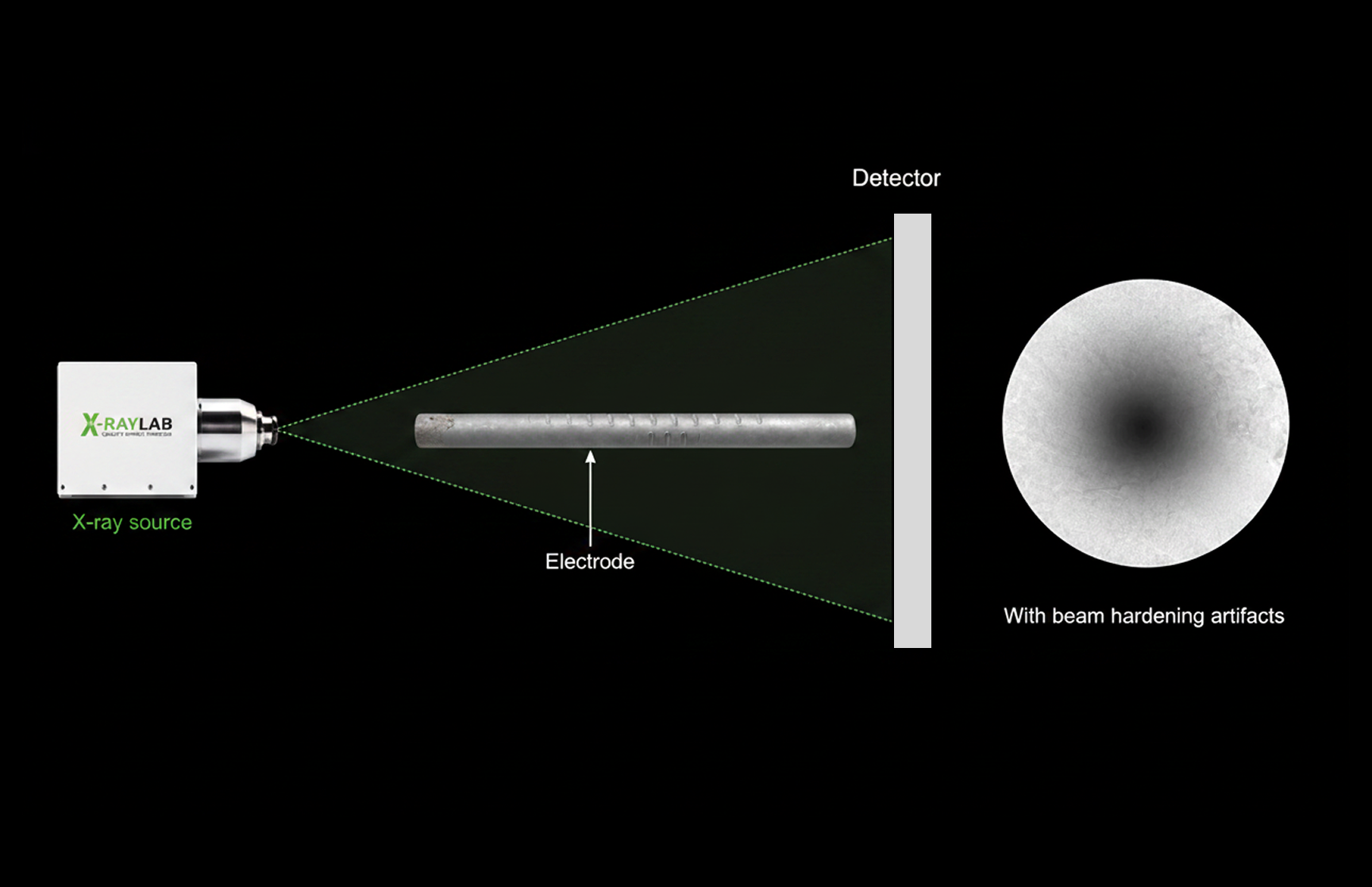
However, battery materials create imaging difficulties because manufacturers combine metals with low-density polymers and electrolytes inside compact geometries. Achieving clear contrast between materials requires optimized scanning parameters and advanced reconstruction techniques.
At XRAY-LAB, industrial CT systems are designed to inspect complex battery assemblies while supporting detailed defect analysis and production-level quality control.
Hairpin Weld Inspection Challenges
Hairpin motor technology has become increasingly common in EV drive systems because it improves motor efficiency and power density.
These motors rely on copper hairpin welds that must maintain excellent electrical conductivity and structural integrity.
Even microscopic weld defects can lead to:
- Increased resistance
- Heat generation
- Reduced motor efficiency
- Premature motor failure
Traditional inspection methods often fail to detect internal porosity or incomplete fusion within these welds.
Industrial CT automotive inspection provides a non-destructive method for evaluating:
- Weld penetration
- Internal porosity
- Crack formation
- Voids
- Geometric inconsistencies
Because copper is highly dense, CT scanning parameters must be carefully optimized to minimize artifacts and maintain image clarity.
AI-assisted image analysis is increasingly helping manufacturers automate defect classification during hairpin weld inspection.
Lightweight Materials Create New Inspection Demands
Weight reduction is a major priority in EV design because lower vehicle weight directly improves battery efficiency and driving range.
Manufacturers increasingly use:
- Aluminum castings
- Carbon fiber composites
- Multi-material assemblies
- Additively manufactured parts
While these materials improve performance, they also introduce inspection complexity.
For example, aluminum die castings may contain internal porosity that weakens structural integrity. Composite materials may develop delamination or fiber misalignment that remains invisible externally.
CT scanning allows engineers to evaluate internal material quality while also performing dimensional analysis.
This is especially important for:
- Battery housing structures
- Chassis components
- Cooling plates
- Lightweight brackets
- Structural castings
XRAY-LAB supports manufacturers with high-resolution industrial CT systems capable of inspecting both dense metallic components and lightweight composite structures.
Thermal Management Components Require Precise Inspection
Efficient thermal management is essential for EV safety and battery performance.
Modern electric vehicles use highly engineered cooling systems that include:
- Cooling plates
- Microchannel structures
- Heat exchangers
- Fluid pathways
- Thermal interface materials
Many of these components contain intricate internal channels that are impossible to inspect visually.
Industrial CT scanning helps manufacturers verify:
- Internal channel geometry
- Blockages
- Wall thickness
- Brazing quality
- Leak-related defects
- Assembly accuracy
As thermal systems become more compact and complex, CT inspection becomes increasingly valuable for validating manufacturing consistency.
Connector Inspection in High-Voltage EV Systems
Electrical connectors play a critical role in EV reliability.
High-voltage systems require secure and defect-free electrical connections capable of handling extreme operating conditions.
Connector failures can result in:
- Electrical arcing
- Heat buildup
- System instability
- Power loss
CT scanning enables non-destructive inspection of connector assemblies to identify:
- Crimping defects
- Internal misalignment
- Incomplete insertion
- Solder joint issues
- Material inconsistencies
Manufacturers can also use CT data for dimensional metrology and tolerance verification.
AI-Driven Inline CT Is Changing EV Production
One of the biggest developments in e-mobility inspection is the rise of AI-driven inline CT systems.
Traditional CT scanning was primarily used in laboratories because scanning and analysis could take significant time. However, EV manufacturers now require faster inspection workflows capable of supporting high-volume production.
Modern inline CT solutions combine:
- Automated handling systems
- High-speed reconstruction
- AI defect recognition
- Real-time analytics
- Production data integration
AI algorithms can automatically classify defects, compare scans against reference models, and reduce operator dependency.
This helps manufacturers achieve:
- Faster cycle times
- Improved defect consistency
- Reduced scrap rates
- Predictive quality monitoring
- Automated process control
XRAY-LAB provides advanced CT inspection technologies that support automated manufacturing environments and Industry 4.0 integration for e-mobility production lines.
Best Practices for EV CT Scanning
Optimize Scanning Parameters for Material Density: EV components often combine multiple materials with different absorption characteristics. Proper voltage, filtration, and exposure settings are essential for image clarity.
Use High-Resolution Scanning for Critical Areas: Battery cells, weld zones, and micro-connectors require extremely fine detail detection. Higher resolution scanning improves defect identification accuracy.
Integrate AI-Based Defect Analysis: AI-assisted software improves inspection speed and consistency while reducing human interpretation errors.
Implement Inline CT for Production Efficiency: Inline CT systems help manufacturers inspect larger production volumes without slowing manufacturing throughput.
Combine CT Inspection with Process Optimization: CT data should not only identify defects but also improve upstream manufacturing processes through root cause analysis.
How XRAY-LAB Supports E-Mobility Manufacturers
XRAY-LAB provides advanced industrial CT and X-ray inspection solutions for the evolving demands of e-mobility manufacturing.
The company supports manufacturers with:
- Industrial CT systems
- Battery CT inspection
- Hairpin weld analysis
- Inline CT integration
- AI-assisted defect detection
- Automotive quality inspection
- Reverse engineering
- Dimensional metrology
- Non-destructive testing solutions
With expertise in automotive and high-precision industrial inspection, XRAY-LAB helps manufacturers improve product reliability, reduce defects, and optimize production quality across EV manufacturing processes.
Frequently Asked Questions
What Is EV CT Scanning?
EV CT scanning is a non-destructive inspection method that creates 3D internal images of electric vehicle components to detect hidden defects and analyze internal structures.
Why Is Battery CT Inspection Important?
Battery CT inspection helps manufacturers identify internal defects such as delamination, voids, contamination, and weld issues that may affect battery safety and performance.
Can Industrial CT Detect Hairpin Weld Defects?
Yes. Industrial CT scanning can identify internal porosity, incomplete fusion, cracks, and geometric inconsistencies in EV hairpin welds.
How Does AI Improve Inline CT Inspection?
AI improves inline CT inspection by automating defect recognition, accelerating analysis, reducing operator dependency, and increasing inspection consistency.
Which EV Components Commonly Use CT Inspection?
Commonly inspected components include battery cells, battery packs, hairpin welds, cooling systems, connectors, aluminum castings, and power electronics assemblies.