Why Hairpin Weld Quality Matters in EV and Motor Manufacturing?
With the advancement of smaller and efficient electric motors, the need for accurate and robust analysis of hairpin welds has grown tremendously, especially in areas such as electric cars (EVs) and top-tier industrial motors. The use of laser-welded copper hairpins for making essential electrical connections in stators is highly common in such machinery. Any internal defects in the welding process, any geometric misalignment, or even any cracks can have adverse effects, including reduced efficiency or rapid failure of the system. For this reason, X-Ray Inspection Technologies, XVOIDPRO has been customized for hairpin weld analysis.
X-ray Inspection of Laser-Welded Copper Hairpins: Detecting Internal Defects
A hairpin weld should be analyzed with regard to a range of possible defects, particularly concerning the interior voids, inclusion of foreign objects, and geometrical irregularities. These potential problems may negatively impact the conductivity, thermal resistance, or mechanical performance of the weld, which could have adverse consequences in the context of functioning of the electric motor. Recent technological advancements made possible the use of imaging methods, including XVOIDPRO, capable of detecting and classifying potential weld problems in real time.
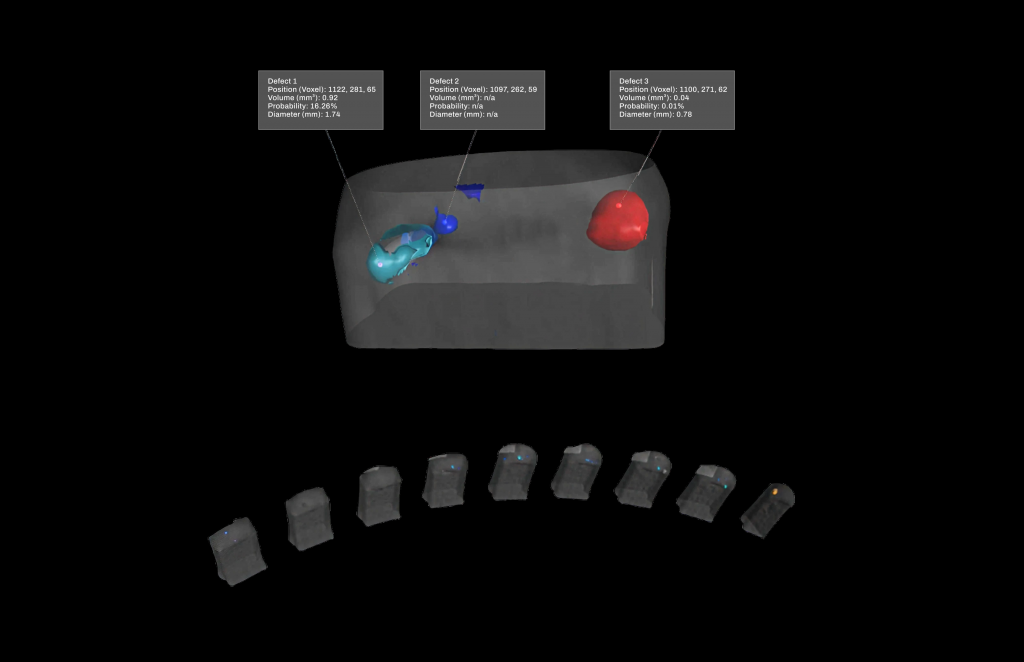
Figure 1. Automated X-ray defect detection in a copper hairpin weld using XVOIDPRO. 3D visualization showing internal voids and inclusions automatically identified by XVOIDPRO. Each color-coded marker represents a detected flaw with measured parameters. The visualization highlights XVOIDPRO’s precision in quantifying internal weld defects for quality control in EV motor manufacturing.
Non-Destructive Testing of Copper Hairpin Welds Using X-ray Imaging
Analysis of sealed or internal parts is a non-invasive procedure in X-ray welding inspection, and that becomes a crucial feature. Copper hairpins, which are usually contained or encapsulated inside the stator assembly, cannot be analyzed through the traditional methods of visual or mechanical probing. Unlike visual or mechanical probing, X-rays can detect the presence of porosity or imperfections inside the weld. Using appropriate software, the software would be able to recognize the presence of voids, enhance the pattern of inclusions, and check for compliance of the weld geometry with the required tolerances.
Inline Hairpin Weld Quality Control with XVOIDPRO for Scalable Production
Inspection technology is applicable to both ends of the production continuum. On one end, during R&D, engineers can make use of the X-ray system to tune welding parameters, conduct joint types analysis, and analyze various materials. At the opposite end, real-time quality assurance is possible by conducting the same inspections of hairpin joints to inform operators of any flaws before assembly or shipping. This inline integration helps achieve a balance between throughput and quality control.
In case of high-voltage motors, it becomes essential to detect microvoids and inclusions because heating in such places causes motor degradation in the early phases of operation. In addition, inconsistent welds may lead to misalignment and reduced stability. Inspection technologies utilizing intelligent software and capable of providing repeatable and clear results address such issues, increasing efficiency and reducing rework time.
Given the continuous development of electric vehicle manufacturing and related technologies, the evolution of hairpin weld inspection is imperative. The issue remains the same – a constantly operational system able to inspect the weld gap without stopping the production.
Tools for automated X-ray analysis, such as XVOIDPRO, now provide a practical and scalable approach to meet these needs. These tools enhance reliability, reduce scrap rates, and improve long-term performance over a wide variety of applications.
Check out this quick video explanation.
XRAY-LAB’s XVOIDPRO enables fast, non-destructive X-ray inspection of critical welds in electric motor manufacturing. It detects voids, inclusions, and geometric flaws with high precision. Ideal for both R&D and inline quality control. Learn more or contact us.
Frequently Asked Questions
Why Is X-Ray Inspection Important for Copper Hairpin Welds in EV Motors?
X-ray inspection stands as a critical safeguard for copper hairpin welds, surfacing hidden defects such as voids, cracks, and inclusions that visual and surface inspections inevitably miss.
In electric vehicle motors, a seemingly minor fault in a hairpin weld can ripple through the entire system, dampening electrical efficiency, triggering localized overheating, or precipitating premature failure. XVOIDPRO empowers manufacturers to pinpoint these vulnerabilities in their infancy, softly without damage, and in high throughput.
How Does Xvoidpro Enable Inline Weld Inspection on Production Lines?
XVOIDPRO delivers inline weld inspection by merging rapid X-ray imaging with smart, automated defect recognition. It captures every weld on the fly, spots internal defects like voids or inclusions, and notifies operators the moment an issue is detected, keeping the production line moving while ensuring every joint meets quality standards.
Can X-Ray Inspection of Hairpin Welds Replace Traditional Visual or Ultrasonic Methods?
Yes. In contrast to optical and ultrasonic inspection techniques, XVOIDPRO’s X-ray imaging delivers non-invasive visibility into concealed weld anomalies, such as ghost porosity and internal misalignments, thereby furnishing a more dependable approach to quality assurance.
Is AI Used to Enhance Defect Detection in Xvoidpro Systems?
Yes. Many advanced imaging systems now embed AI or deep learning techniques to separate genuine defects from clutter and noise. This not only enhances detection precision but also accelerates throughput, achieving results that align closely with seasoned human inspectors.
Why Is Hairpin Weld Analysis Critical for Electric Vehicle Motors?
Hairpin welds in electric vehicle stators conduct substantial currents while facing intense thermal cycling. Defects such as gas voids, misalignment, or incomplete fusion drive up electrical resistance, resulting in overheating and accelerating failure. XVOIDPRO verifies weld integrity by detecting these critical anomalies, thus enhancing overall motor efficiency and reliability.
Lorem ipsum dolor sit amet, consectetur adipiscing elit. Ut elit tellus, luctus nec ullamcorper mattis, pulvinar dapibus leo.