Genuine and fake connectors can have the same appearance at first glance. They might even pass common electrical continuity tests and have the same weight, dimensions, and markings. The sophistication of contemporary counterfeit producers has allowed them to circumvent conventional incoming inspection techniques by closely mimicking exterior standards.
Once these connectors are installed into vital systems, the issue arises. In aeronautical assembly, automobile control modules, industrial automation systems, or defense electronics, failures may happen right away or only after months of operation.
Because of this, one of the biggest problems in contemporary supply chain quality control is the detection of counterfeit connectors. The problem is usually concealed internal construction rather than external appearance. To identify these variations, it is necessary to examine the interior of the connector without causing any harm, which is where industrial CT scanning comes in.
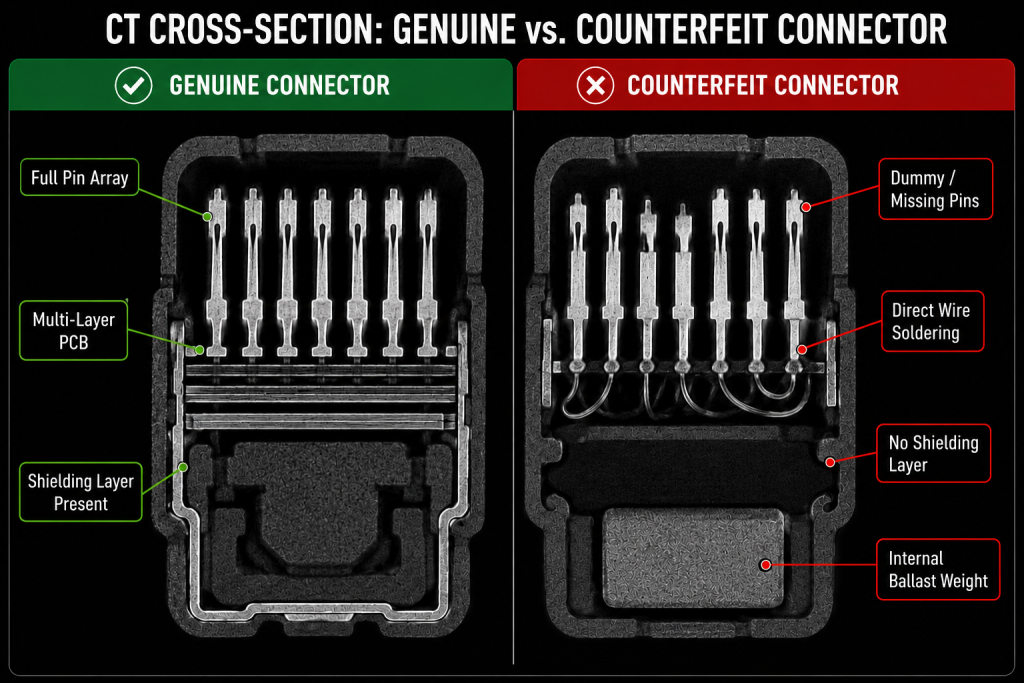
Non-destructive CT inspection comparing genuine and counterfeit connector architecture, highlighting hidden internal defects that directly impact reliability, safety, and long-term performance.
Why Counterfeit Electronic Connectors Have Become a Supply Chain Risk
Global manufacturing continues to face serious reliability issues due to counterfeit electrical components. Due to their widespread use in high-volume applications where long-term performance is crucial, connectors have become a common target.
Modern counterfeit connectors are meticulously designed to mimic authentic parts outwardly, in contrast to earlier counterfeit goods that were simple to spot. When components are obtained from unapproved vendors or when there is a lack of supplies, the risk is greatly increased.
A single fake connector can cause system failure, costly recalls, manufacturing delays, and serious safety hazards in sectors like aircraft, automotive, industrial automation, and medical equipment.
Why Visual Inspection and Electrical Testing Cannot Detect Counterfeit Connectors
During entering quality control, the majority of manufacturers rely on electrical continuity testing, dimensional verification, and visual inspection. All three of these techniques have substantial limits when it comes to recognising fake connectors, even though they are helpful for spotting evident flaws.
Only surface-level problems like inaccurate markings, subpar polishing, or dimensional irregularities can be found by visual inspection. To get past these tests, sophisticated counterfeit connectors frequently closely resemble authentic items.
Electrical testing verifies that a signal flows via the connector, but it is unable to prove the internal transmission of that signal. A connector may pass continuity testing even if its internal architecture is subpar or its pins are only partially attached.
Although destructive cross-section analysis offers internal visibility, it is not appropriate for batch-level inspection since it permanently ruins the component.
Industrial CT scanning solves this challenge by providing complete internal inspection without disassembling or destroying the connector.
What Industrial CT Scanning Detects Inside Counterfeit Connectors
The structural differences between genuine and counterfeit connectors become immediately visible once both components are scanned using industrial CT technology.
1. Pin Structure and Internal Connectivity
Every pin in a real connector follows an exact internal path to its termination point, making up the entire pin array.
Missing pins, partially connected contacts, or dummy pins intended simply to mimic the external appearance while lowering production costs are common features of counterfeit connectors.
CT scanning can determine whether all internal electrical connections are appropriately built, even in cases where continuity testing are successful.
2. PCB Architecture and Internal Circuit Design
Signal transmission, electrical stability, and thermal performance are all managed by engineered internal PCBs found in many high-end connectors.
Simplified boards or direct wire-to-pin soldering are frequently used in counterfeit versions in place of this architecture.
PCB layer count, routing pathways, internal solder connections, and structural irregularities are all easily detected by CT scanning.
3. Shielding and Mechanical Reinforcement
Shielding layers, grounding structures, and strain relief systems are examples of high-quality connectors that safeguard mechanical durability and signal integrity.
While keeping the same outward look, counterfeit connectors frequently completely remove these protecting elements.
The existence of these internal defence systems can be determined by industrial CT scanning.
4. Material Density Analysis
Internal material density is also mapped by industrial CT imaging.
In contrast to counterfeit components, which frequently exhibit inferior metals, internal voids, plastic replacements, or uneven assembly quality, genuine connectors exhibit consistent material distribution based on production criteria.
Conventional surface inspection is unable to detect these structural variations.
How Industrial CT Scanning Verifies Connector Authenticity
CT scanning offers trustworthy internal verification without compromising the part when connectors come from dubious vendors or unauthorized distributors.
There are three steps in the inspection procedure.
To build a reference model of the proper internal architecture, including pin geometry, PCB structure, shielding arrangement, and material distribution, a confirmed authentic connector is first scanned.
Then, under the same circumstances, suspect connectors are scanned.
The interior structures of the two samples are then compared by engineers. Anomalies in geometry, bad solder joints, missing parts, and material substitutions are examples of structural abnormalities that are quickly detected.
In contrast to conventional inspection techniques, CT scanning offers recorded interior evidence instead of only a pass or fail outcome.
Manufacturers already using CT for supplier verification can also explore CT Scanning for Supplier Quality Validation to strengthen supplier qualification programs.
Where Counterfeit Connector Detection Matters Most
Detecting counterfeit connectors is especially important in sectors where system dependability or safety are directly impacted by connector failure.
Counterfeit connectors can jeopardize communication modules, avionics systems, and mission-critical electronic assemblies in the aerospace and defence industries.
Counterfeit connectors used in sensor assemblies or ECU systems in vehicle electronics may malfunction under vibration or heat cycling, posing a long-term dependability risk.
Proper interior construction is crucial for the mechanical longevity and stable signal transmission of industrial automation connectors functioning in high-vibration manufacturing environments.
Counterfeit connectors in medical devices raise major dependability issues in regulated healthcare applications, monitoring devices, and diagnostic systems where traceability is crucial.
How XRAY-LAB Uses Industrial CT Scanning for Connector Authentication
XRAY-LAB provides high-resolution industrial CT scanning services specifically designed for internal electronic component inspection, counterfeit detection, and supplier quality verification.
XRAY-LAB assists manufacturers in examining crucial internal structures such pin geometry, PCB design, shielding configuration, solder quality, and material consistency thanks to its extensive knowledge in connector architecture analysis
The micron-level precision of the scanning scanners enables precise identification of missing pins, faulty solder connections, lack of shielding layers, and structural irregularities in a variety of connector types, from huge industrial circular connectors to USB-C assemblies.
Both one-time batch inspection and long-term supplier qualification programmes are supported by XRAY-LAB for businesses handling supplier quality issues.
For connector-specific internal defect analysis, manufacturers can also review How CT Scanning Detects Hidden USB Connector Defects, which explains how internal connector failures develop beyond standard electrical testing.
Conclusion: Why Internal Connector Inspection Has Become Essential
Due to the rising sophistication of counterfeit connectors, exterior inspection techniques are no longer enough for accurate identification. While surface quality and basic operation may be confirmed by visual inspections and electrical testing, the internal structure responsible for long-term performance cannot be verified.
By offering full non-destructive view into internal connector design, industrial CT scanning addresses this problem and enables manufacturers to find hidden flaws, structural irregularities, and fake parts before they are put into production.
XRAY-LAB helps manufacturers strengthen supply chain quality control through high-resolution CT inspection that delivers accurate internal verification without damaging critical electronic components.
Frequently Asked Questions
How can counterfeit electronic connectors be detected without damaging the component?
The industrial CT scanning process provides a complete 3D internal image of the connector non-destructively, allowing engineers to examine the internal architecture without taking it apart.
What internal defects can CT scanning detect inside connectors?
CT scanning can find missing pins, bad solder joints, wrong PCB architecture, missing shielding layers, internal voids, material substitutions and structural cracking.
Why is visual inspection insufficient for counterfeit connector detection?
Visual inspection only evaluates external appearance. Sophisticated counterfeit connectors often replicate dimensions and markings accurately while hiding internal structural defects.
What is the difference between 2D X-ray inspection and industrial CT scanning?
2D X-ray images the internal image in a flat projection . Industrial CT scanning produces a complete 3D internal model for accurate measurement and structural analysis .
Which industries use CT scanning for connector authenticity verification?
Industrial CT scanning is used in aerospace, automotive electronics, industrial automation, medical devices, defence systems, and electronics manufacturing to confirm component authenticity and stop fake parts from getting into production systems.