Measurement of wall thickness plays an extremely important role in industrial inspection processes today. The traditional methods for measuring wall thickness tend to be ineffective because these tools do not provide access to internal measurements without destroying the work piece.
Industrial computed tomography (CT) solves this problem by enabling non-destructive 3D internal measurement of full components.
- It captures internal and external geometry in one scan
- It allows measurement without cutting or sectioning
- It provides complete volumetric inspection data
This makes CT-based wall thickness analysis essential for high-precision manufacturing industries.
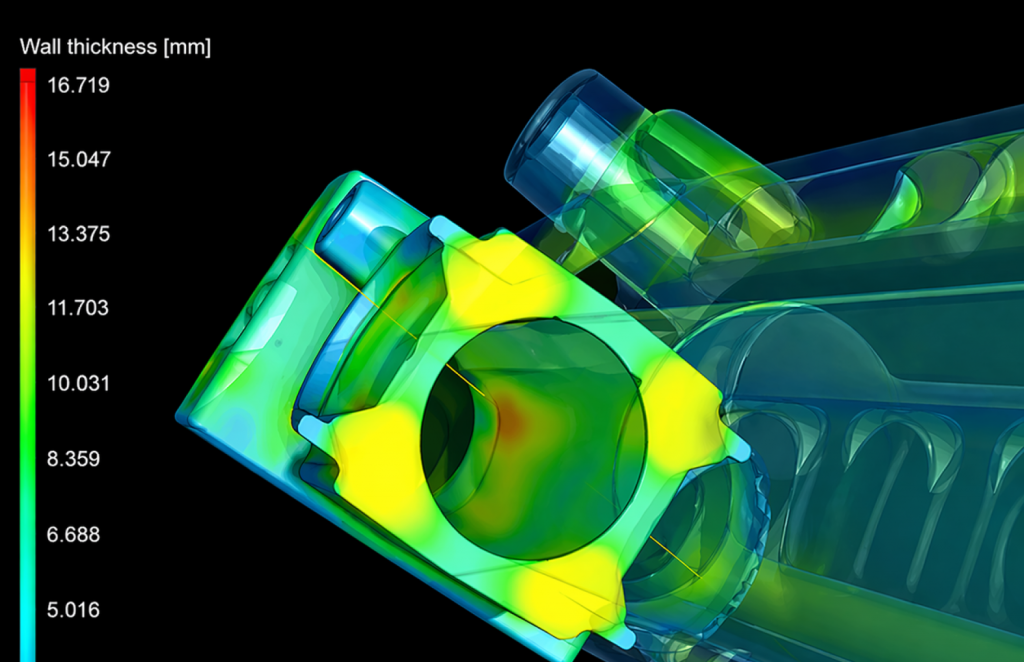
Wall Thickness Analysis: CT Cross Section
What is Wall Thickness Analysis in Industrial CT?
In CT scanning, wall thickness measurement involves determination of the thickness between two opposite surfaces in the reconstructed 3D volume. Compared to point measurements, wall thickness measurement by CT takes into account the whole structure.
This is widely employed in:
- Measuring internal cavities and empty spaces
- Determining changes in material content
- Comparing actual object with CAD models
The output obtained is a 3D thickness map which displays areas with high and low thickness in colors.
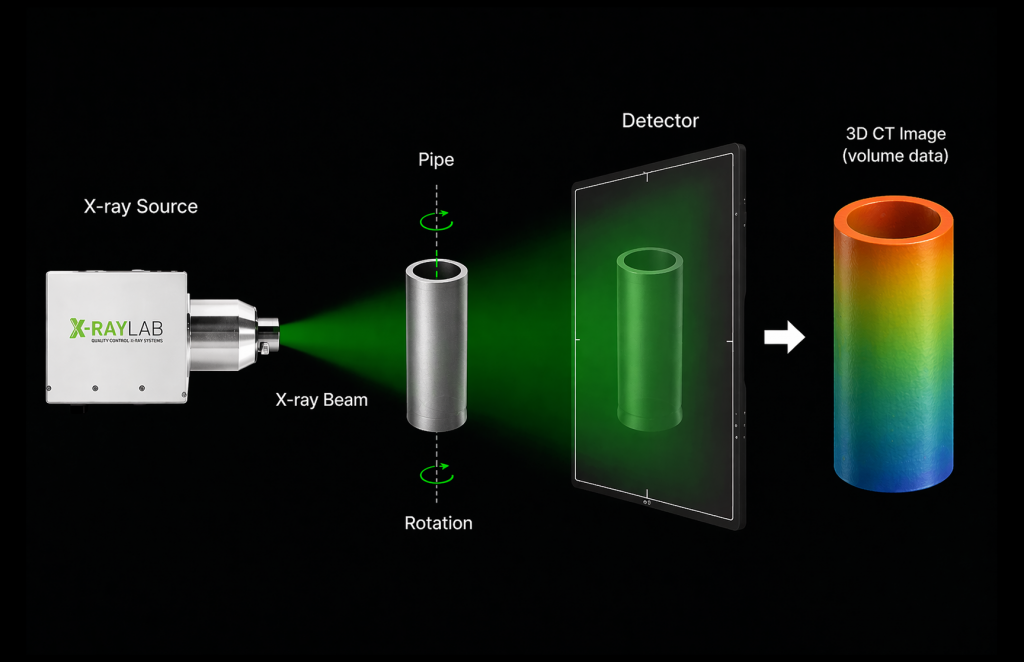
CT Scan Process for Industrial Inspection: From X-ray Projection to 3D Volume Data
CT Methods for Wall Thickness Measurement
CT scanning for industrial applications involves reconstruction of a complete 3D volume from X-ray images. After reconstruction of the object, thickness measurement is then performed using various algorithms.
Beam Method
The beam method uses straight-line distance calculations between opposing surfaces.
- Fast and efficient for simple geometries
- Provides direct surface-to-surface measurement
- Less computationally heavy
It is commonly used where speed is more important than extreme precision.
Sphere Method
The sphere method finds the largest possible inscribed sphere within the material.
- Highly accurate for complex geometries
- Works better for curved or irregular shapes
- More computationally intensive but more precise
This method is preferred in high-precision industrial applications.
Why Wall Thickness Matters in Manufacturing
The thickness plays a key role in determining how the component will perform during actual operations. Any minor differences could result in malfunctioning.
In engineering terms, this means:
- Stress distribution within the component
- Structural strength of the component
- Efficiency of material used
Industries that rely on light components need to pay close attention to thickness to avoid any malfunctions.
Industrial Applications of Wall Thickness Analysis
In automobiles, wall thickness gauging is applied to check out the parts of batteries, engines, and support structures which need proper balance of lightweight structure along with sufficient strength and thus internal consistency becomes very crucial.
It is quite helpful for the engineers to analyze the consistency of material within the object, locate vulnerable areas, and check the lightweight designs.
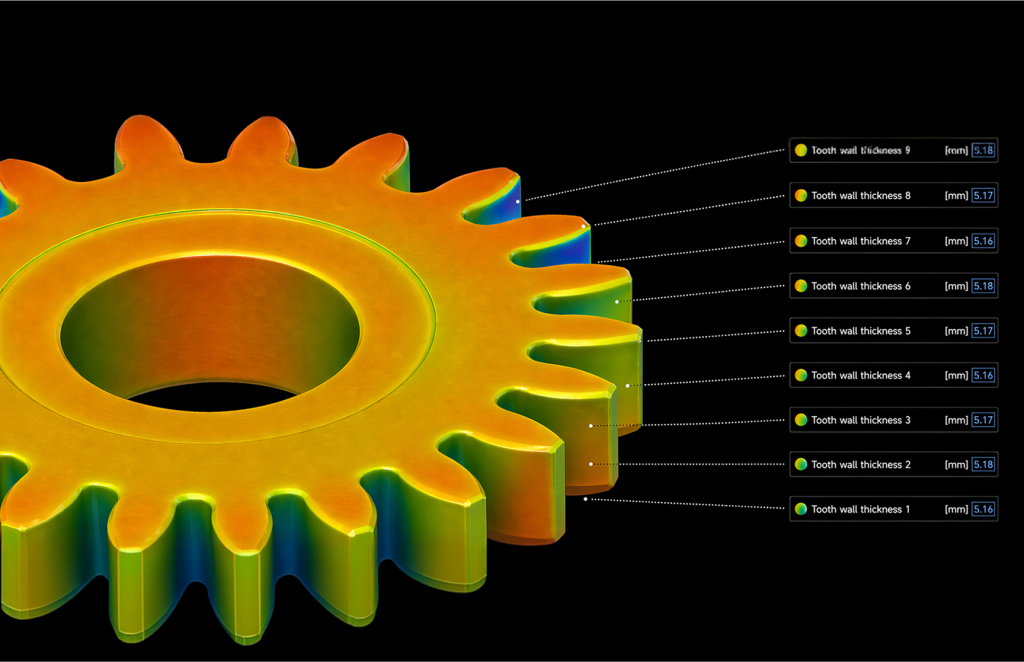
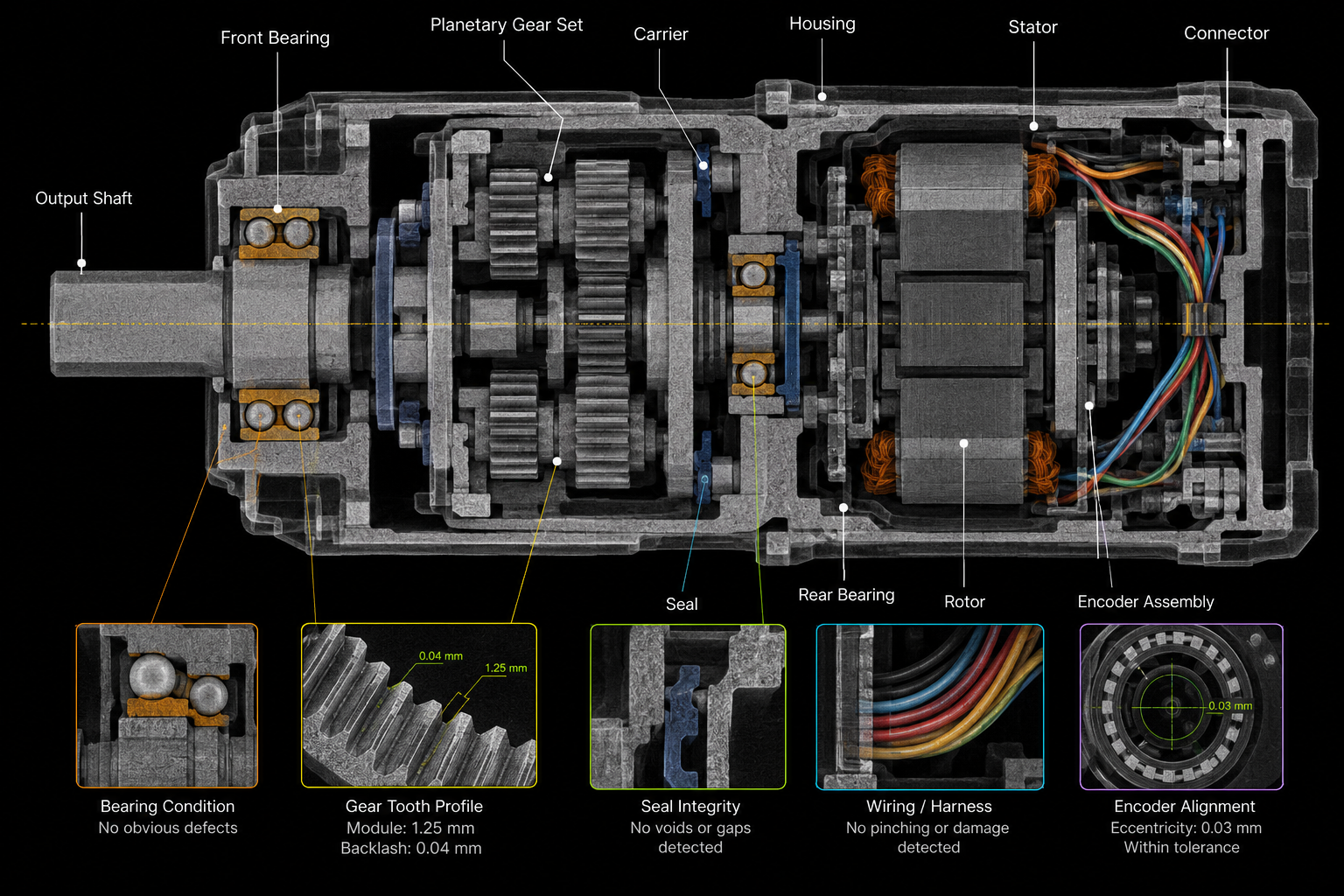
Industrial CT scan of Gear Showing Tooth Wall Thickness Distribution and Manufacturing
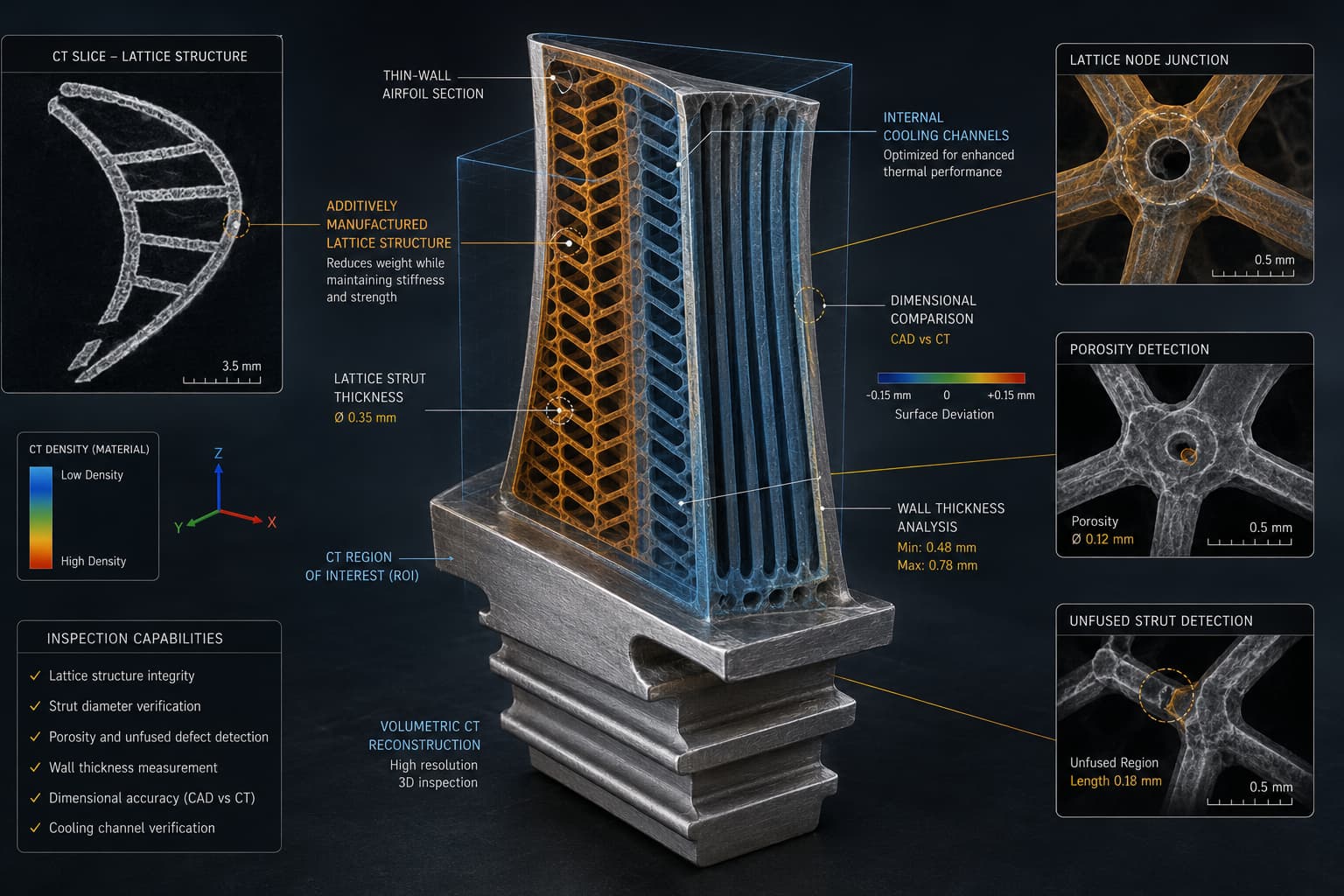
In additive manufacturing, wall thickness measurement using CT is important in assessing the internal structure of 3D printed parts due to their complicated internal structure.
Because many 3D printed parts have lattices and are hollow inside, the only way to test for any internal problems is to use internal inspections.
CT measurements help in determining whether the actual structures match the digital versions, and also help in identifying inconsistencies in the printed part.
Variations in the wall thicknesses of injection molded plastics can occur due to the internal cooling behavior and material flow of such products. Internal inspection using CT can help determine the shrinkage and warpage of the plastic parts.
In the case of aerospace parts, internal consistency becomes very important because of the harsh conditions experienced when the parts are used. Wall thickness validation is important for metals and composites.
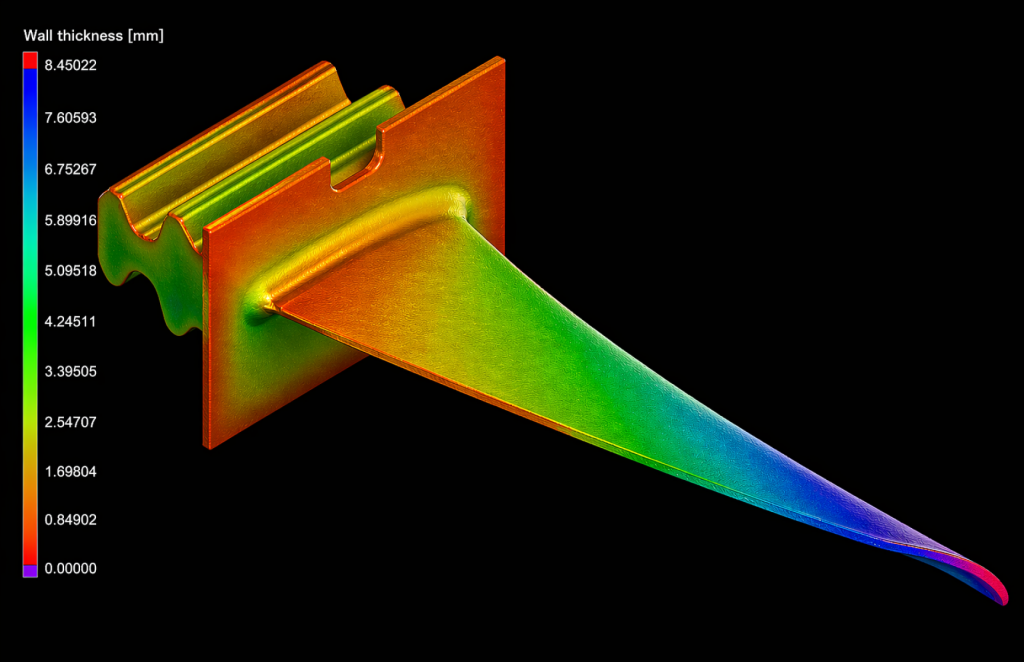
Turbine Blade Inspection Using CT: High-Resolution Wall Thickness Analysis for Quality Control
Advantages of CT-Based Wall Thickness Analysis
There are many benefits associated with using wall thickness analysis based on CT technology when compared to other inspection techniques.
- It gives a completely non-destructive interior inspection
- It permits a full three-dimensional representation of the thickness profile
- It facilitates exact comparison with computer-aided designs for deviation detection
Moreover, various interior elements can be checked in one scanning operation.
From Geometry to Insight: What CT Really Reveals
In fact, wall thickness testing is much more meaningful when used in combination with defect analysis. It is not just about analyzing geometric parameters but rather how defects affect structural behavior.
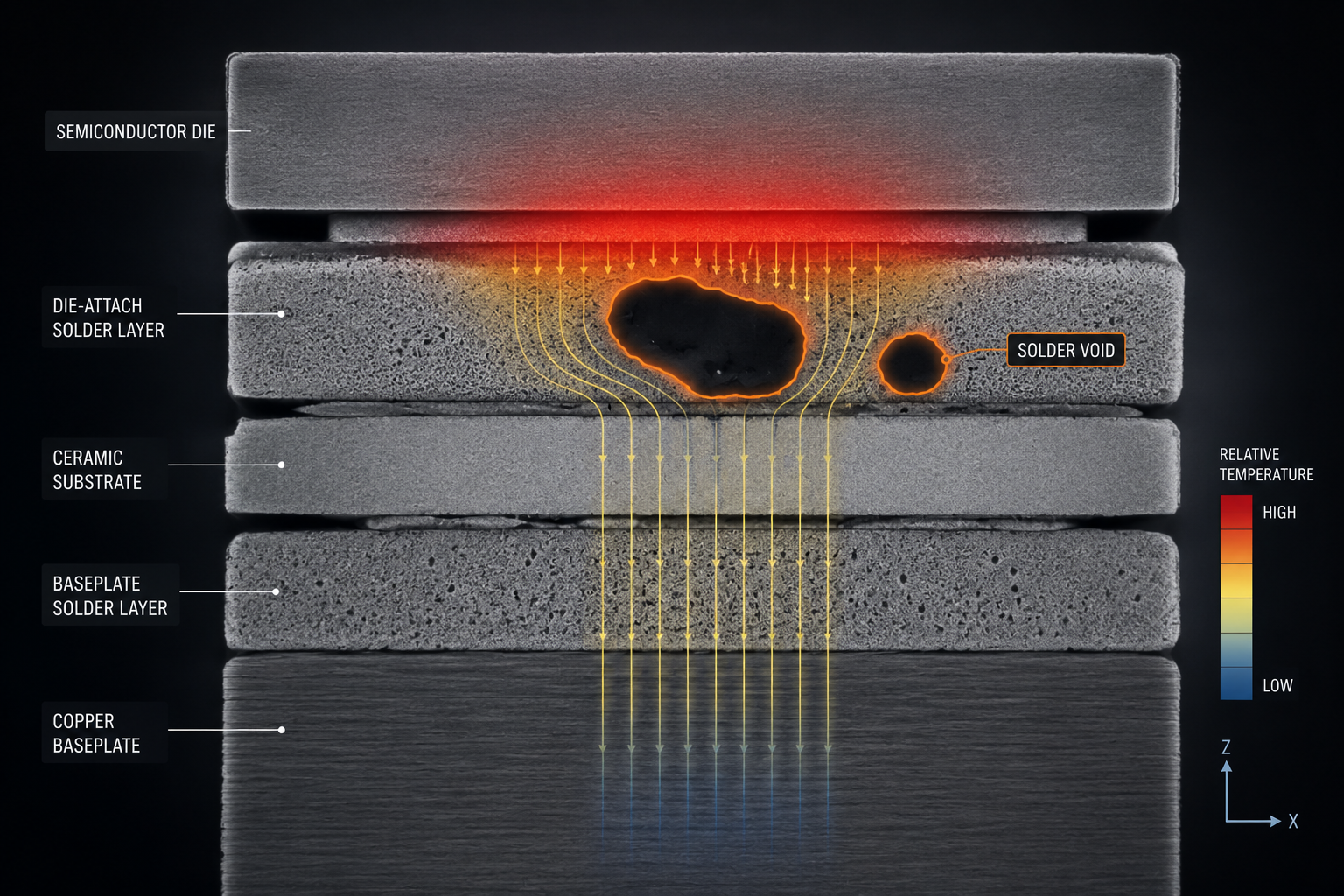
The presence of thin walls usually points to a lack of density or porosity, whereas non-uniformity in terms of thickness can suggest problems with shrinkage and material flow during manufacture.
By combining these approaches, engineers will be able to determine the underlying causes of production problems.
How XRAY-LAB Applies CT in Wall Thickness Analysis
XRAY LAB uses Industrial CT Inspection Systems for performing a high-resolution wall thickness analysis as part of non-destructive inspection processes. This procedure involves the use of accurate imaging and computerized computation methods. In this regard, it plays an important role in helping achieve zero defect production through non-destructive inspection processes.
Firstly, CT scans are performed to obtain a complete internal geometry. Afterward, algorithms are applied for wall thickness computation. The values obtained are used to compare them against CAD models, which is done for deviation analysis purposes.
The resolution offered by industrial CT systems ranges from 1 to 5 µm, and it can reliably detect wall thickness differences ranging from 10 to 100 µm, depending on the density of material used for manufacture.
Geometry measurements along with defect detection help manufacturers understand the quality of products manufactured.
Conclusion
Analysis of wall thickness via industrial computed tomography has become an integral process for quality control in modern-day manufacturing processes.
With such a method being able to provide a precise and clear image of internal structures without compromising their integrity, industrial CT has become vital in engineering applications that need accuracy above all else.
XRAY LAB uses such techniques in practical situations, providing precise CT wall thickness measurements, along with defect scanning and 3D metrology services.
Frequently Asked Questions
What is Industrial CT wall thickness analysis?
It is a non-destructive wall thickness inspection used to measure internal material thickness using 3D computed tomography data.
Why is CT better than traditional measurement methods?
Because it allows full internal inspection without cutting the part and provides complete volumetric data.
Which industries use wall thickness analysis?
It is widely used in automotive, aerospace, additive manufacturing, and plastic molding industries.
What is the difference between beam and sphere methods?
The beam method uses straight-line measurements, while the sphere method provides higher accuracy for complex geometries.
Can CT detect defects along with wall thickness variation?
Yes, CT can detect voids, porosity, and structural inconsistencies along with thickness variations.