If there is one strategy that can slash your production, labor, and energy costs by up to 80% while still meeting every quality requirement, this is it.
Investing in an industrial CT system capable of inspecting high-density components, whether powered by a Micro-focus or Mini-focus X-ray source, represents a significant capital outlay. However, maximizing the return on that investment does not always require another CT system. A relatively small upgrade can dramatically reduce operational costs and inspection cycle times. In fact, for roughly just 6% of the initial system cost, including software, you can perform each scan using only 20% of the operating cost and inspection time previously required.
PolyCT, developed by XRAY-LAB GmbH and Co. KG in collaboration with Fraunhofer IIS, closes that gap. This precision multi-axis upgrade kit integrates directly with your existing CT hardware and fundamentally changes the economics of every inspection run. A standard 30-minute scan cycle that previously handled a single part can now inspect multiple components simultaneously. PolyCT does not just improve efficiency; transforms throughput, delivering faster, more reliable workflows without compromising on quality.PolyCT is designed for straightforward integration with existing industrial CT systems. The upgrade kit mounts directly onto the system’s existing rotation stage or manipulator.
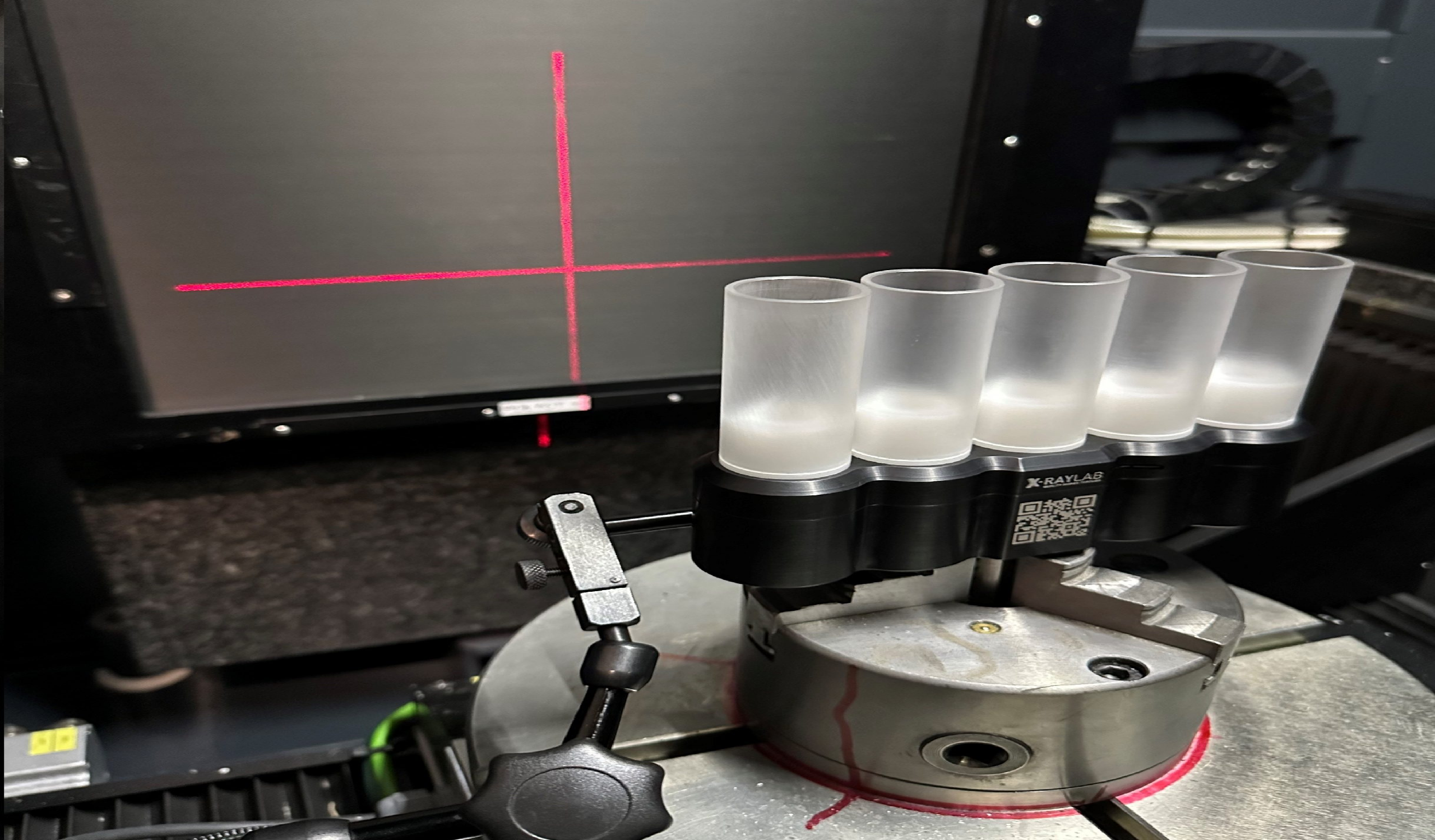
PolyCT M5 – five independent rotation axes on one scan cycle
Integrated laser alignment simplifies installation and positioning without requiring modifications to the CT system mechanics or software, while adaptable specimen holders accommodate a wide range of component geometries. Once installed, inspection proceeds using the standard CT workflow.
Within a single CT acquisition, PolyCT enables the simultaneous inspection of multiple components, each reconstructed using its own centre of rotation. This eliminates superposition artifacts while maintaining independent volumetric datasets for every sample. The result is a more efficient CT inspection workflow while maintaining high image quality for high-density and difficult-to-penetrate components.
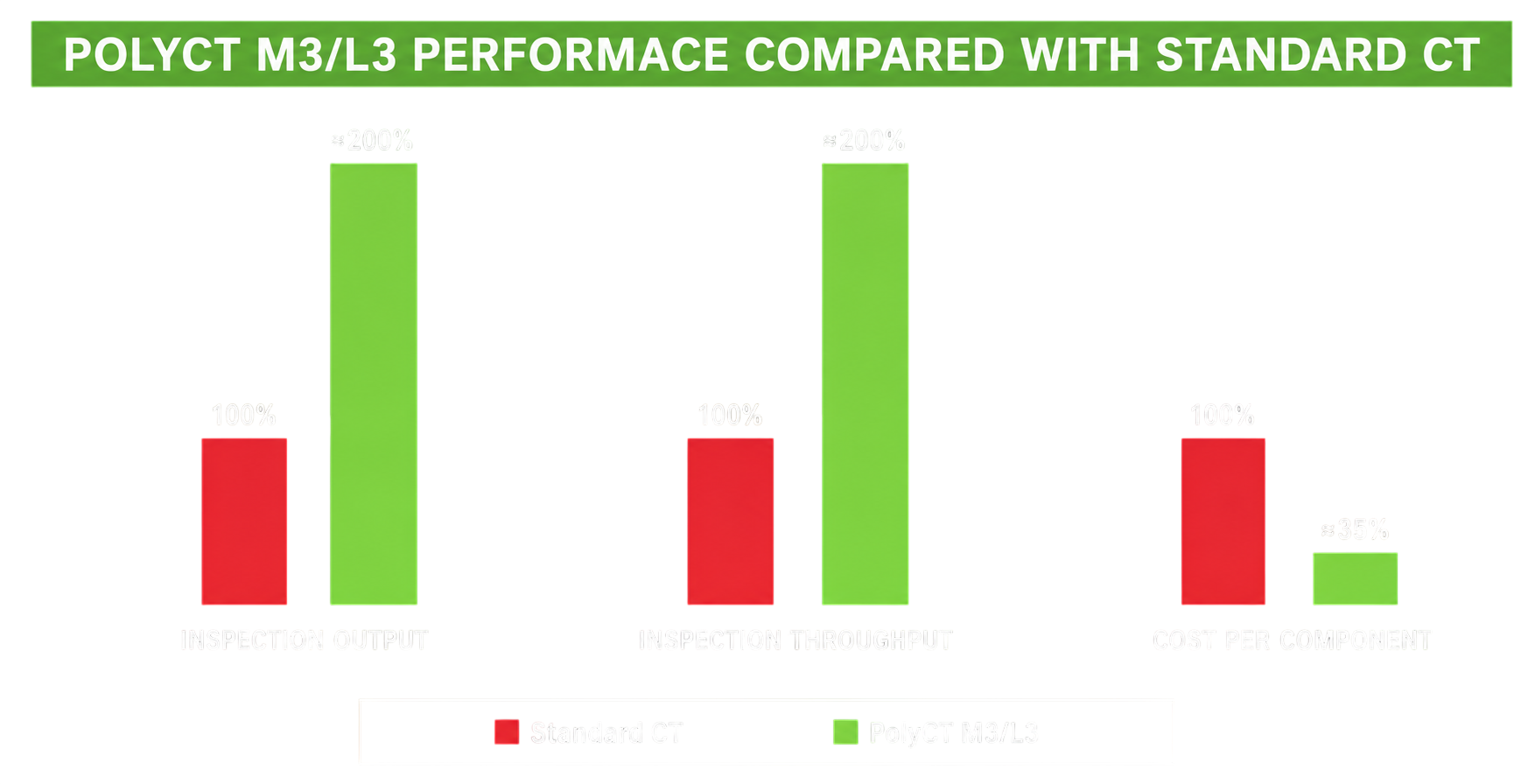
The configuration is yours to define – three, four, five, seven, or customizable option, combined with field-of-view options such as 150 mm (PolyCT M3) or 225 mm (PolyCT L3). Every production environment has unique inspection requirements, and PolyCT is designed to be configured accordingly.
Reconstruction is performed through POLYREKO, which individually processes every component captured in a single scan cycle. Instead of reconstructing one part at a time, the same reconstruction time is now used to generate independent 3D datasets for every part in the scan. The machine runs for the same duration, and the operator follows the same workflow, but fewer scan cycles reduce X-ray tube operating hours, lower maintenance requirements, and decrease the energy consumed per inspected component. Inspection throughput scales with the number of active rotation axes, resulting in a proportional reduction in inspection cost per component.
When combined with modern 4K detectors, or large-format detectors with a diagonal measurement exceeding 1,000 mm, the high-resolution is fully utilised across every rotation centre at once. The result is full detector coverage and high-resolution imaging across every part of a single scan cycle with no trade-off in image quality.
Multi-Spindle CT System for Defence Manufacturing
Global military expenditure reached a record USD 2,887 billion in 2025, marking the 11th consecutive year of growth and a 41% increase over the past decade according to SIPRI.
As defence manufacturing continues to expand, inspection throughput has become as critical as inspection accuracy. Manufacturers must inspect growing volumes of safety-critical components without compromising defect detection.
Defence components such as artillery shells, missile casings, rocket motors, and cruise missile assemblies are manufactured to operate under extreme mechanical, thermal, and dynamic loading conditions. Their dense metallic construction, complex internal geometries, and tight dimensional tolerances make them among the most demanding applications for industrial CT inspection. Larger or denser components often require high-energy X-ray systems to achieve sufficient penetration.
Multi-spindle CT inspection of artillery shells.
Conventional surface inspection and 2D radiography have limitations in evaluating complex internal geometries, hidden defects, and dimensional accuracy, making industrial CT an essential inspection method for safety-critical defence components.
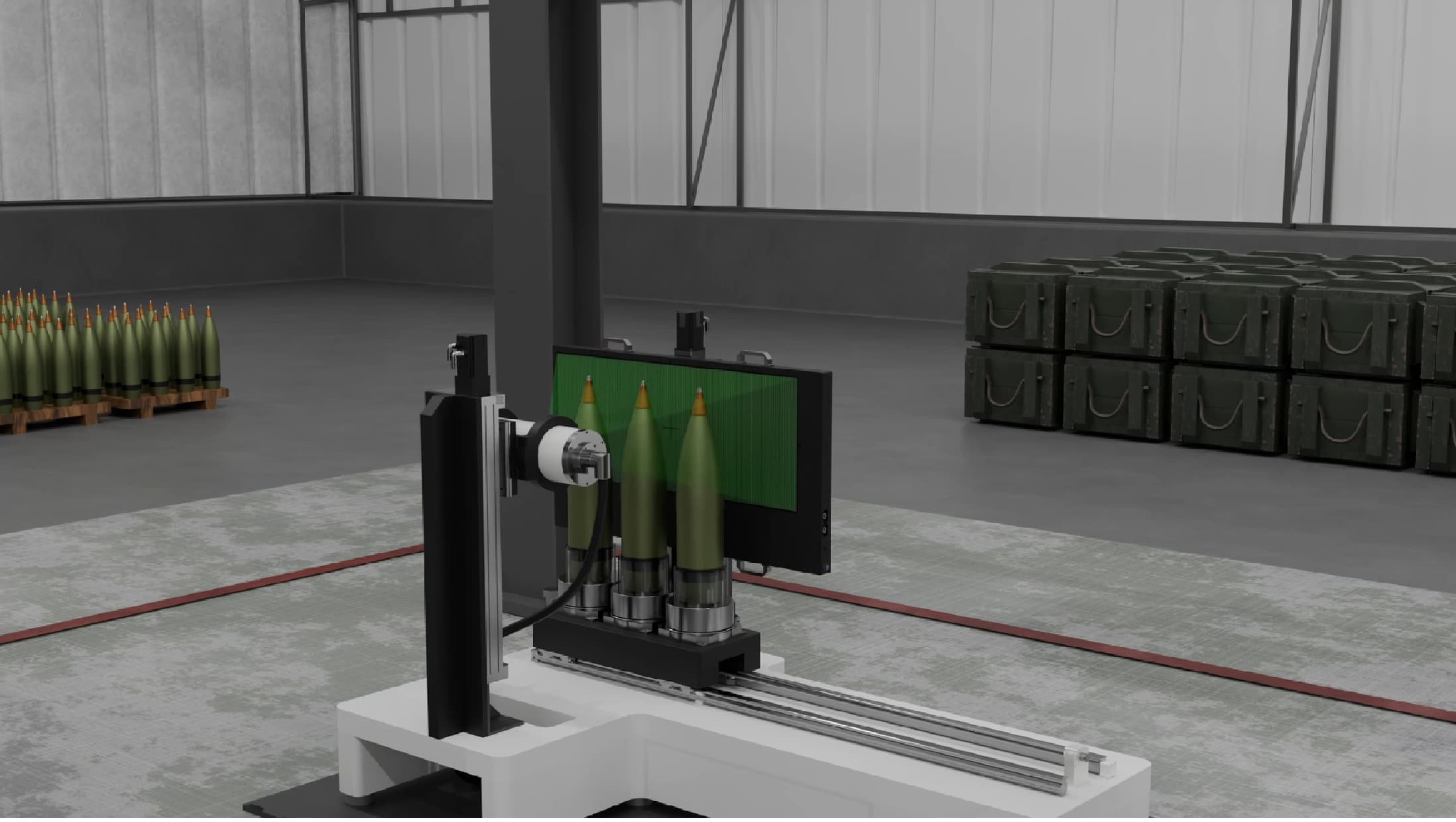
Inspection setup for multi-spindle CT scanning of three artillery shells
While PolyCT extends the capability of existing industrial CT systems, a similar multi-spindle CT inspection concept can also be implemented as a dedicated CT solution for high-volume defence manufacturing. The Image shown here illustrates a custom system configured for the simultaneous inspection of artillery shells, demonstrating how application-specific fixtures and multi-axis scanning can be developed to meet customer requirements or to support the development of new inspection systems or fully integrated production lines.
During a single inspection cycle, every component is processed independently. Each artillery shell or missile component is reconstructed as an independent 3D dataset, allowing engineers to evaluate critical internal defects while maintaining complete traceability for every inspected component.
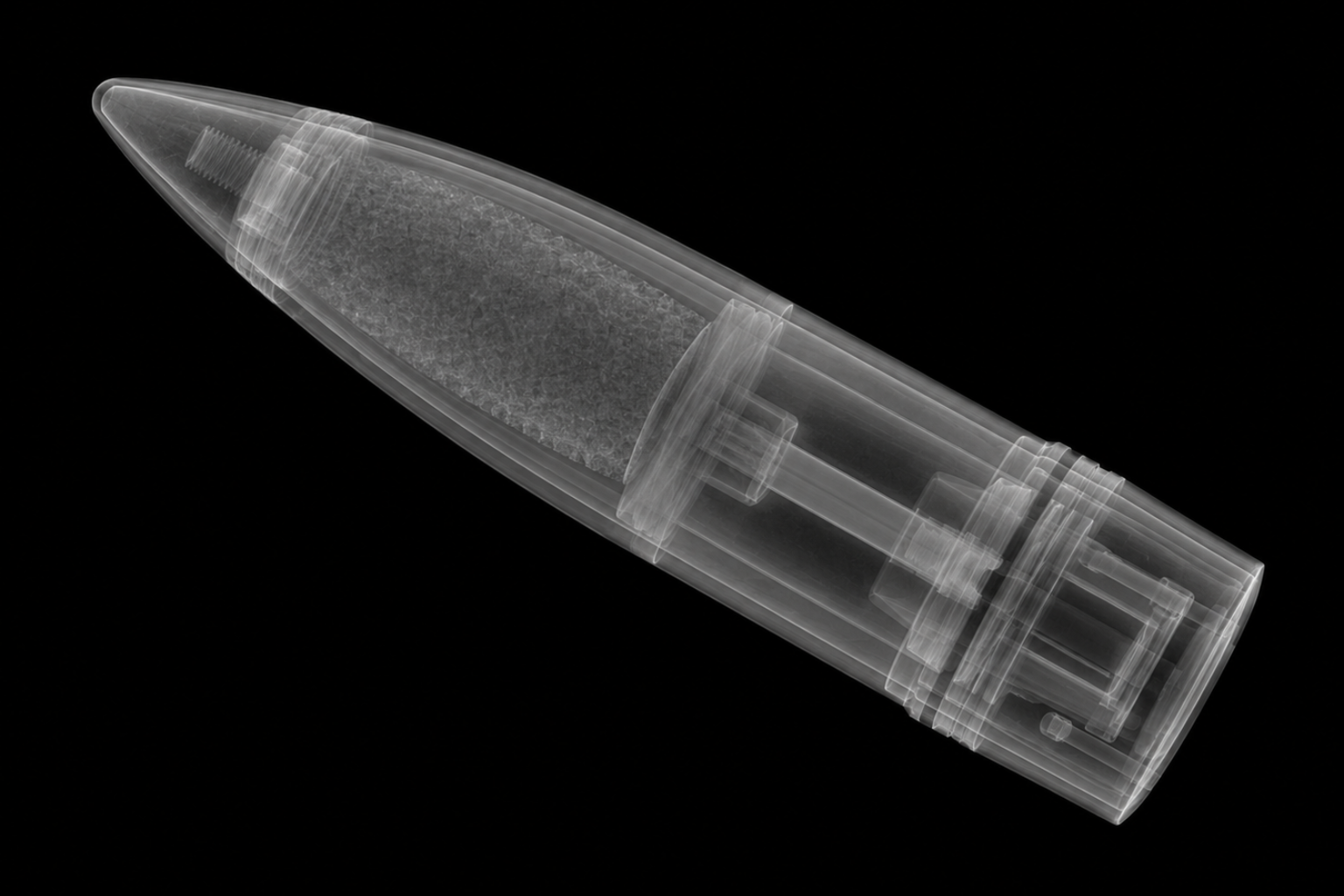
X-ray scan revealing internal structure of an artillery shell
For defence manufacturers, the challenge is no longer whether CT can detect critical defects, but whether CT can keep pace with production. PolyCT unlocks the full potential of existing industrial CT systems, while XRAY-LAB’s custom CT solutions address high-volume and application-specific inspection requirements, helping manufacturers scale production without compromising inspection quality
Stop leaving money on the table. With PolyCT, you do not just inspect parts. You maximize your system's full potential.
Request a demo scan using your own components. Bring your toughest geometry, your densest alloy, or your highest-volume production part. Experience how multiple components can be inspected within a single CT scan cycle.
Frequently Asked Questions
What is PolyCT in industrial CT scanning?
PolyCT is a multi-axis industrial CT scanning technology developed by XRAY-LAB GmbH & Co. KG in collaboration with Fraunhofer IIS that enables simultaneous scanning of multiple components in a single scan cycle, significantly improving inspection throughput.
Which industries benefit most from PolyCT inspection technology?
PolyCT is particularly valuable for aerospace, defence, automotive, nuclear energy, and advanced manufacturing industries that frequently inspect dense metallic components with complex internal structures.
Does PolyCT require a new CT scanner?
No. PolyCT is a non-invasive multi-axis upgrade kit that integrates with compatible industrial CT systems. It mounts directly onto the existing CT chuck, allowing manufacturers to increase inspection throughput without replacing their current CT equipment.