The use of ceramic CT inspection of ceramics components in the electronics industry is changing the way people handle quality control in their manufacturing plants. The ceramic components used today include capacitors and resistors, which are manufactured in such a way that they can perform under high voltages and heat.
Ceramic CT inspection is crucial in the present-day scenario because any defect, however minute it may be, in the inner parts of the component could disrupt electricity flow and cause a failure in the circuit.
What Makes Ceramic Components So Challenging to Inspect
The CT scan technique for electronic components is useful in dealing with an issue: ceramics break down internally without presenting any externally visible symptoms. The brittleness of the material and their multi-layered construction make them susceptible to damage during the manufacturing process. Micro cracks within the ceramic components can range from <5-20 µm, making the use of high resolution CT scan important.
The reasons for the problems revealed by electronic component CT scan include:
- The thermal stresses due to sintering
- Build up of residual stresses
- Inconsistencies in material shrinkage
- Electrode layering problem
All these issues result in micro crack formation within the ceramic materials.
A Closer Look at Micro-CT as a Diagnostic Tool
Ceramic parts’ analysis via CT involves using micro-CT to create 3D models of the inner structure. The benefits of such analysis include more than visualization; they involve precise quantitation. Engineers can quantify cracks and analyze porosity distribution and density differences precisely.
In the case of CT capacitor inspection, it means:
- Analyzing layer-to-layer electrode connectivity
- Detecting sub-micron cracks before their further development
- Quantifying density difference, which impacts dielectric properties
In contrast to cross-sectioning techniques, the non-destructive analysis of ceramics makes it possible to conduct multiple inspections of the part and is also much faster than cross-sectioning.
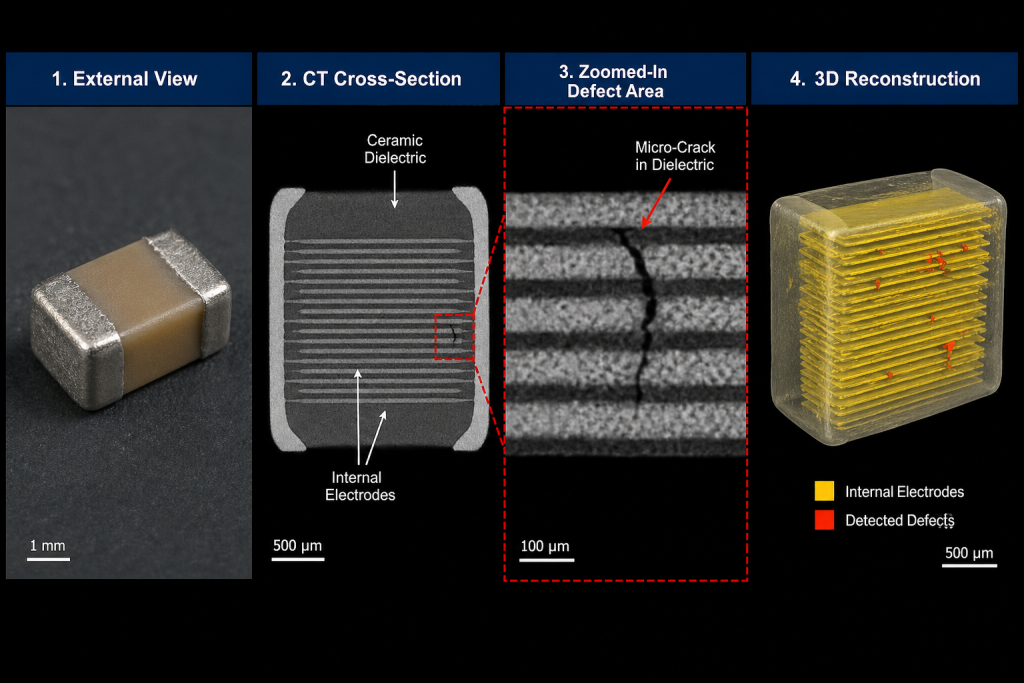
Micro-CT scan of a ceramic capacitor showing cross-section, micro-crack, and 3D internal structure.
From Defect Detection to Root Cause Insight
The electronic parts CT scan is more than defect detection; it is about determining what causes those defects. The three-dimensional images obtained by CT scans enable engineers to associate internal defects with particular process conditions.
For example:
- A recurring micro-crack pattern may indicate uneven cooling rates
- Localized density variation could point to material mixing inconsistencies
- Voids near electrode interfaces may suggest lamination issues
This level of insight transforms CT ceramic inspection from a quality control tool into a process optimization solution.
Engineering Value in High-Reliability Applications
CT-based inspection of ceramic electronic components plays a decisive role in industries where failure is not an option. Components used in electric vehicles, aerospace systems, and medical electronics must perform consistently under stress.
By integrating non-destructive testing ceramics into production and validation workflows, manufacturers can:
- Detect early-stage defects before assembly
- Improve reliability of mission-critical systems
- Reduce scrap rates and production losses
- Support compliance with strict industry standards
In such environments, CT inspection directly contributes to both safety and cost efficiency.
Adding a Technical Edge: Beyond Visual Inspection
The difference with advanced CT ceramics inspection lies in its capability to go beyond visualization and move towards data analysis. Modern technologies are capable of using grayscale technology to analyze differences in densities of the materials, allowing distinguishing fully sintered parts from weak spots.
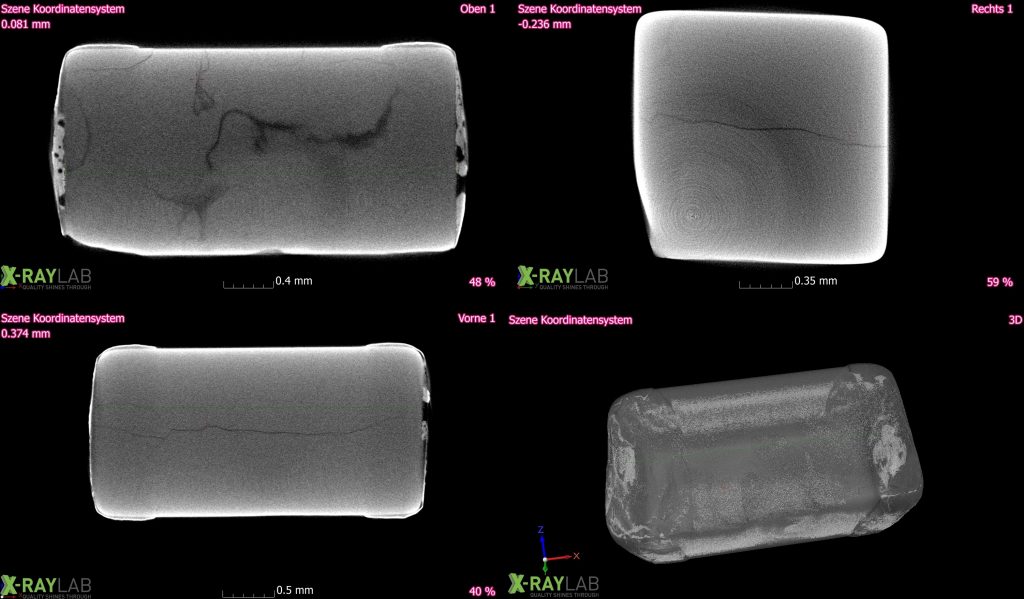
CT scan revealing internal crack propagation in a multilayer ceramic capacitor (MLCC)
Furthermore, segmentation technology facilitates the isolation of particular structures, such as electrodes or cavities, which makes it easier for analysts to conduct further studies on them. This comes in handy during CT scanning of capacitors because they have an intricate internal structure that is quite densely arranged. In case of the Ceramic capacitor examination discussed here, images were acquired at 160 kV with 30 µA, providing a voxel size of around 1.7 µm through 2400 projections in a 360° rotation. Using 56× magnification and high-resolution flat panel detectors, this technique made it possible to visualize the internal electrode layers as well as micro-cracks within the structures.
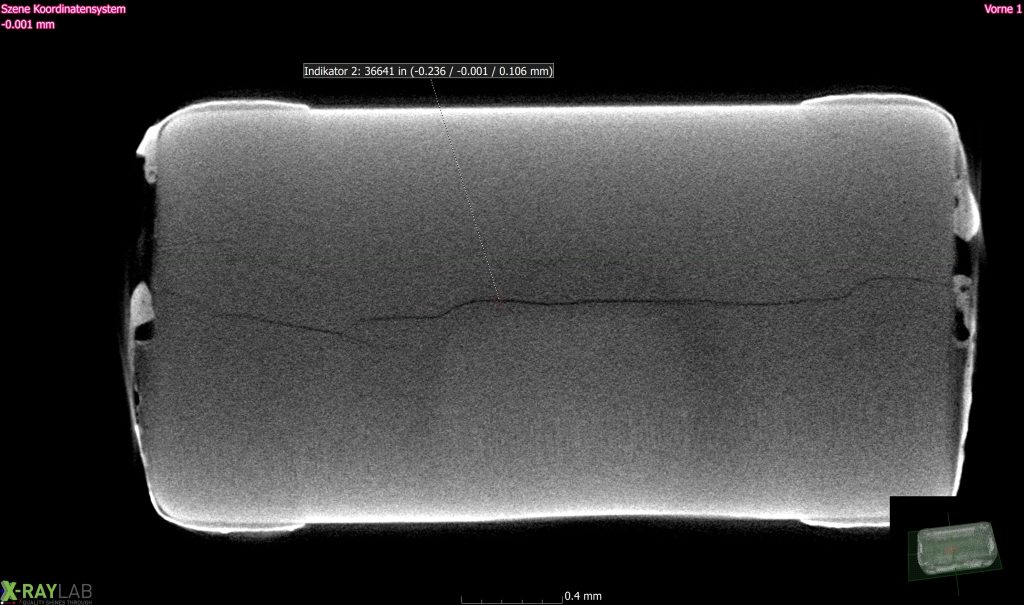
X-ray CT slice showing subsurface crack in a ceramic capacitor
The CT scan below shows the presence of a hidden internal fracture that is visible as a dark line because of the difference in densities. The fracture is horizontal in nature across the ceramic and is a result of the mechanical stress exerted on the device like bending and heating cycles.
These features make the CT scan an engineering intelligence tool rather than a diagnostic tool for electronic components.
Conclusion
Inspection of ceramic components in electronics manufacturing using computed tomography is now not merely an advanced technique but is almost becoming a necessity for high-quality electronics production. With the increasing sophistication of ceramic components and their critical nature, it is a definite advantage when they can be checked inside out non-invasively.
In this respect, the involvement of XRAY LAB becomes very relevant. Through integrating sophisticated micro-CT technologies and the knowledge of how to use them on specific applications, XRAY LAB assists manufacturers in progressing from mere defect detection to obtaining valuable engineering insights. It allows manufacturers to not only detect defects but also figure out why these defects happen, adjust manufacturing processes accordingly and redesign products in case required.
Through high-resolution electronic components CT scan capabilities, Xray Lab supports:
- Accurate micro crack detection in ceramics at early stages
- Detailed analysis for CT capacitor inspection and multilayer structures
- Data-driven quality control using non-destructive testing ceramics
- Faster decision-making in R&D, production, and failure analysis
In a landscape where even, microscopic imperfections can impact performance, XRAY LAB provides the clarity, precision, and confidence needed to ensure ceramic components meet the highest reliability standards.
Frequently Asked Questions
What is CT ceramic inspection used for?
CT ceramic inspection is used to analyze the internal structure of ceramic electronic components and detect defects like cracks, voids, and density variations without damaging them.
How does micro crack detection in ceramics improve reliability?
Micro crack detection in ceramics helps identify early-stage structural weaknesses that could expand under stress and cause component failure.
Why is CT capacitor inspection important?
CT capacitor inspection ensures that internal electrode layers and dielectric materials are properly aligned and free from defects, which is essential for performance and safety.
Can CT scanning measure material density in ceramics?
Yes, electronic components CT scan systems can analyze grayscale values to detect density variations and material inconsistencies.
Which industries rely on non destructive testing ceramics?
Industries such as automotive, aerospace, consumer electronics, and medical devices rely on non destructive testing ceramics to ensure product reliability.