

A void, crack, or inclusion is rarely desirable—but it is not always critical. The same internal defect can cause immediate failure in one product while remaining functionally harmless in another. The difference does not lie in the defect itself, but in geometry, load paths, and material interaction.
This is where generic pass/fail inspection reaches its limits, and application-specific defect evaluation becomes essential.
Table of Contents
Geometry: Shape determines stress concentration
Geometry governs how stress is distributed within a component.
A small internal void in a thin-walled structure may intersect a high-stress region and initiate crack propagation. The same void in a thick, load-distributing geometry may sit in a low-stress zone with no measurable impact on performance.
Defect size alone is therefore an incomplete metric. What matters more is the defect’s exact spatial relationship to functional features such as edges, fillets, ribs, interfaces, and transitions in cross-section.
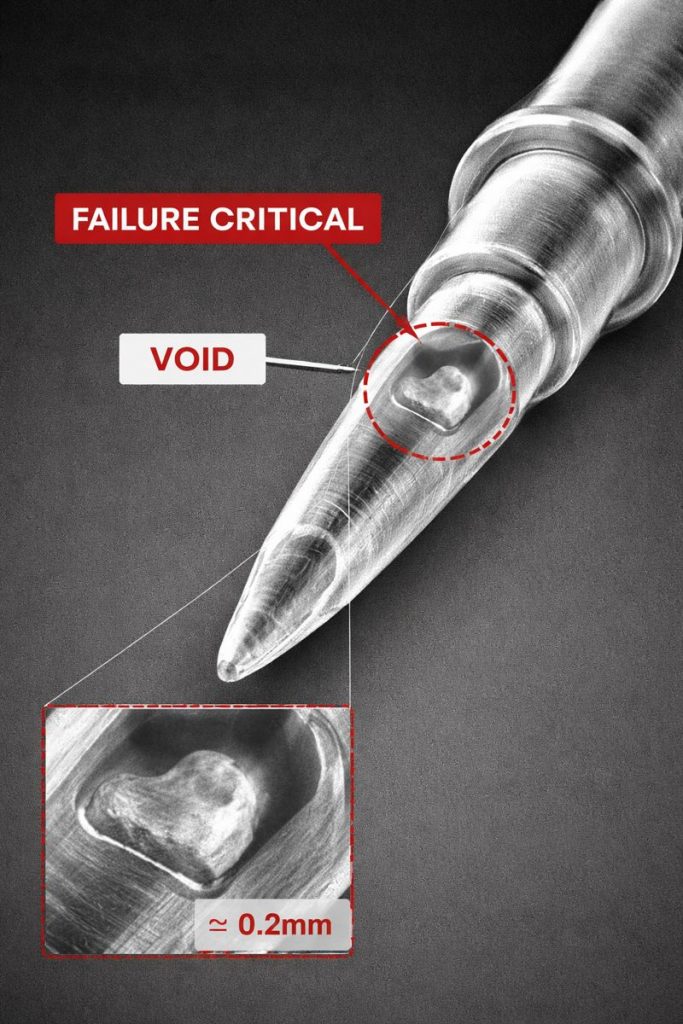
Void shown inside a thin connector pin (failure-critical)
Xray-Lab uses CT inspection not only to detect defects, but to precisely locate them within the functional geometry of the component. This allows defect relevance to be evaluated based on real structural behavior rather than simplified thresholds.
Load paths: How forces travel matters more than defect size
Defects become critical when they interrupt primary load paths.
A void aligned parallel to the dominant load direction may have little effect. The same void oriented perpendicular to cyclic loading can act as a crack initiation site under fatigue conditions.
Most products experience combined loading rather than a single force type, including static loads, cyclic fatigue, thermal expansion, and multi-axial stress states.
Xray-Lab interprets inspection data in the context of actual load paths rather than nominal design intent. This enables accurate classification of defects as cosmetic, tolerable, function-limiting, or failure-critical—supporting reliable decisions without unnecessary rejection.
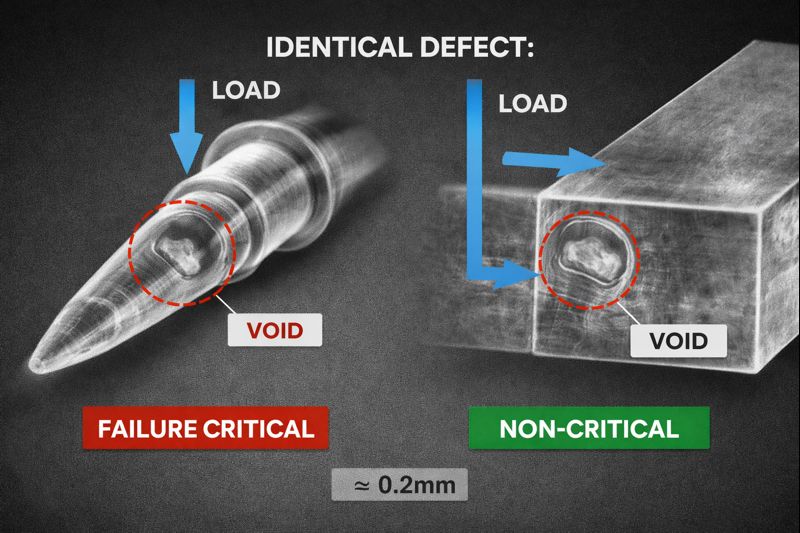
Identical defect overlaid with different load vectors in two components.
Material interaction: The same defect behaves differently across materials
Material properties strongly influence how defects evolve under load.
A pore in a ductile polymer may deform plastically without propagating. The same pore in a brittle ceramic or solder joint may trigger sudden fracture. In composite materials, defect behavior depends on fiber orientation, layer interfaces, and local resin distribution rather than bulk material alone.
Xray-Lab applies high-resolution CT to evaluate defects within the material system itself, including grain structure in metals, fiber alignment in composites, and interfaces in multi-material assemblies. Defects are assessed based on how the material will respond under service conditions, not simply on visual appearance or size.
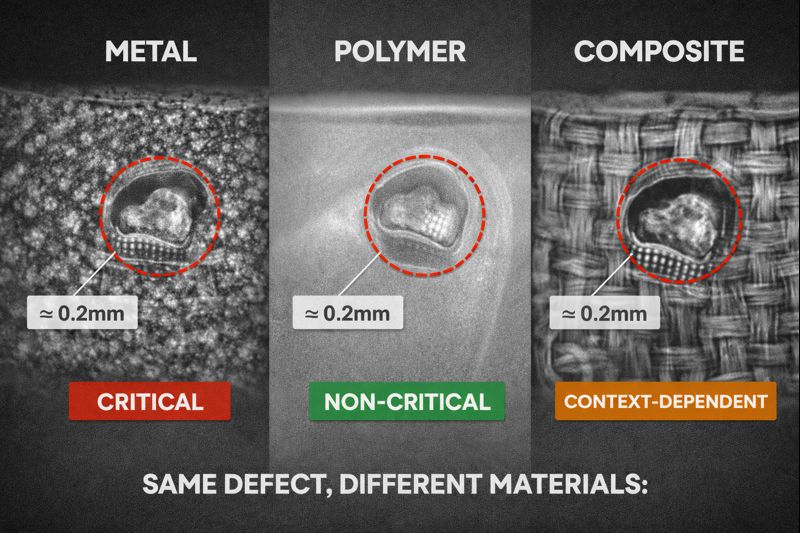
Same defect shown in metal, polymer, and composite CT scans.
Why generic acceptance criteria fall short
Standard defect limits, such as maximum allowable void percentage, often ignore local geometric stress amplification, directional and cyclic loading effects, and material-specific failure mechanisms.
This leads to over-rejection of components that are functionally acceptable and missed risks in parts that technically pass inspection.
Xray-Lab addresses this gap by evaluating defects in context, enabling smarter, risk-based decisions without compromising safety or performance.
Application-specific defect evaluation with Xray-Lab
Xray-Lab does not ask only whether a defect exists. The critical question is whether the defect matters in a specific product under defined operating conditions.
Using advanced CT analysis, Xray-Lab delivers product-specific defect relevance assessment, risk-based defect classification, and clear, decision-ready inspection results.
For uncertain or borderline cases, a free initial sample analysis can determine whether a detected defect is truly critical or safely acceptable.
Frequently Asked Questions
Why isn’t defect size alone a reliable failure indicator?
Because failure depends on defect location, load direction, and how the surrounding material responds under real operating conditions.
Can two identical CT scans lead to different conclusions?
Yes. Without considering geometry, load paths, and material behavior, identical defects can be misclassified.
How does Xray-Lab determine whether a defect is critical?
By combining CT data with application-specific understanding of geometry, loading conditions, and material interaction rather than relying on generic acceptance thresholds.
Is this evaluation useful for borderline or “grey area” defects?
Yes. Application-specific defect evaluation is particularly valuable when standard criteria are inconclusive.
Can I submit a sample for evaluation?
Yes. Xray-Lab offers a free initial sample analysis for selected components to assess defect relevance accurately.
