

When manufacturers invest in CT scanning, they are not just looking for images — they are looking for answers.
A CT scan captures thousands of X-ray projections from different angles. But those projections alone do not provide clarity. The real insight comes from CT reconstruction — the process that converts raw scan data into a complete, structured 3D model.
At XRAY LAB, reconstruction is where data becomes understanding.
Table of Contents
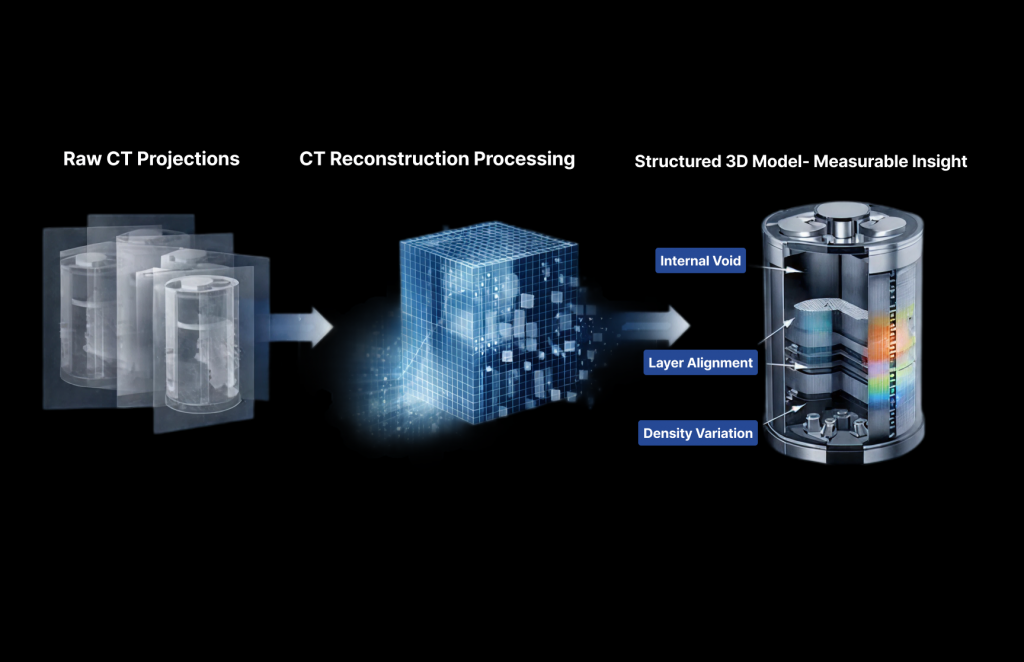
From raw CT projections to structured 3D insight — XRAY LAB turns scan data into measurable engineering intelligence.
What Happens After the Scan?
Once a component is scanned, the system collects hundreds or even thousands of 2D images. These are essentially shadows of the object from different angles.
CT reconstruction digitally combines those projections to build a 3D representation of the internal structure. This allows engineers to virtually “see inside” a component without cutting it open.
Instead of guessing where a defect might be, they can explore the entire structure layer by layer.
Why Reconstruction Quality Is So Important
Not all 3D models are equal.
If reconstruction is poorly handled, defects can appear blurred, measurements can be inaccurate, and important details may be missed. In industries like EV batteries, aerospace, or electronics, that risk is unacceptable.
XRAY LAB focuses on ensuring that reconstructed models clearly reveal internal features such as voids, cracks, misalignments, inclusions, and structural inconsistencies. The goal is not just to create a 3D image, but to create a reliable basis for decision-making.
From Data to Measurable Insight
Once the 3D model is generated, it becomes more than just a visual tool.
Engineers can measure wall thickness, evaluate internal alignment, analyze void distribution, and assess material density variations. Problems that are invisible from the outside become measurable and understandable.
This is particularly important when investigating production issues or validating process improvements. Instead of relying on assumptions, manufacturers gain clear internal evidence.
How XRAY LAB Adds Value
XRAY LAB approaches CT reconstruction as a complete workflow — not a single software step.
The team ensures that scan settings are optimized from the start, projection data is corrected for distortions, and reconstruction methods are selected based on the inspection goal. The result is a structured 3D model that accurately represents the component’s internal condition.
More importantly, XRAY LAB translates reconstruction results into clear, structured reports that manufacturers can use for:
- Improving production processes
- Reducing defect rates
- Preventing warranty claims
- Strengthening compliance documentation
- Supporting failure analysis
By combining advanced CT technology with practical engineering insight, XRAY LAB helps manufacturers move from “seeing” to truly understanding their products.
Conclusion: Turning Visibility into Confidence
CT scanning provides visibility. Reconstruction provides clarity.
Without proper reconstruction, scan data remains incomplete. With a structured 3D model, internal structures become transparent, measurable, and actionable.
XRAY LAB transforms raw scan projections into meaningful 3D insight that supports smarter manufacturing decisions. For industries where reliability matters, that structured visibility makes the difference between reactive inspection and proactive quality control.
When internal integrity matters, reconstruction is not just a technical step — it is the foundation of confidence.
Frequently Asked Questions
What is CT reconstruction in simple terms?
It is the process of turning multiple X-ray images into a detailed 3D model of a component’s internal structure.
Why can’t manufacturers rely only on 2D X-ray images?
2D images flatten complex structures, which can hide overlapping defects. Reconstruction provides full 3D visibility.
Does reconstruction damage the component?
No. CT reconstruction is completely non-destructive. The component remains intact.
What types of defects can be identified?
Void clusters, cracks, inclusions, misalignments, and density variations can all be detected through reconstructed 3D models.
How does XRAY LAB support manufacturers beyond imaging?
XRAY LAB provides structured analysis and reporting, helping manufacturers improve processes, reduce risks, and enhance product reliability.
