

In modern manufacturing, speed and quality must go hand in hand. Hidden defects in electronics, batteries, or automotive components can lead to costly recalls, scrap, and downtime. Traditional inspection methods often slow production or miss micro-defects. Xray-Lab provides inline, real-time X-ray inspection that detects even the smallest anomalies without interrupting your production flow.
Table of Contents
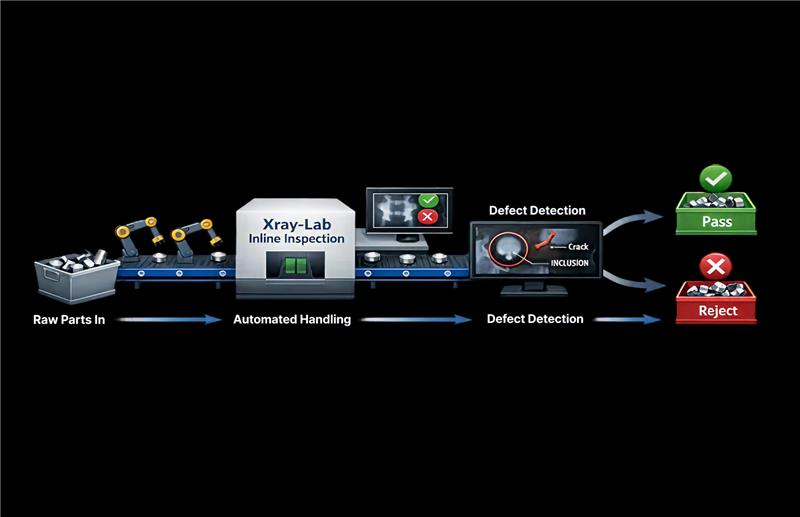
Flow diagram of automated production with inline Xray-Lab scanning → defect detection → sorting.
100% Inline Inspection Without Slowing Production
Even a 1% defect rate can translate into thousands of faulty parts per month in high-throughput lines. Xray-Lab systems scan each component in 2–5 seconds depending on part size and density, providing full coverage without interrupting line speed. Inline scanning ensures consistent detection of voids, cracks, inclusions, and misalignments across every batch.
Seamless Integration with Automation Systems
Xray-Lab integrates directly with conveyors, robotic pick-and-place systems, and MES platforms. Automated algorithms classify defects in real time, enabling instant sorting or rejection. The system supports triggered scanning based on sensor input and can handle production rates of up to 600 parts per hour, depending on complexity, without operator intervention.
Application-Specific Defect Detection
Xray-Lab adapts imaging parameters and 3D reconstruction techniques to meet industry requirements:
- Electronics: solder voids, bridging, tombstoning, component misalignment
- Batteries: electrode deformation, foreign particle inclusion, layer misalignment
- Automotive: porosity clusters, internal cracks, density variations, structural inconsistencies
High-resolution CT reconstruction allows detection of defects as small as 50–100 microns, enabling early intervention before rework or scrap is required.
Actionable Data for Smart Manufacturing
Each scan generates structured datasets for real-time dashboards. Key outputs include:
- Defect type and location mapping
- Reject rate trends per shift or batch
- Statistical process control charts for root-cause analysis
Integration with MES or ERP platforms allows predictive maintenance, process optimization, and full traceability, transforming inspection from reactive QC to proactive production control.
Conclusion
Inline X-ray inspection is no longer optional for high-value, high-speed manufacturing. Xray-Lab delivers precise, actionable inspection data in real time, helping reduce waste, improve yield, and maintain uninterrupted production. Start with a free sample analysis today to see the difference in your production line.
Frequently Asked Questions
What defects can Xray-Lab detect?
Xray-Lab identifies voids, cracks, misalignments, solder bridging, particle contamination, porosity clusters, and layer deformation in electronics, batteries, and automotive components.
Does inline inspection slow production?
No. Typical scan cycles are 2–5 seconds per part, allowing 100% inspection at full line speed.
Can Xray-Lab integrate with MES or ERP systems?
Yes. Real-time scan data feeds dashboards and enterprise systems for process optimization and traceability.
Can we test our products before committing?
Yes. Xray-Lab offers free sample analysis or demo scans to validate performance and compatibility.
What is the minimum defect size Xray-Lab can detect?
With high-resolution CT reconstruction, Xray-Lab can detect defects as small as 50–100 microns, depending on part size and material density.
