

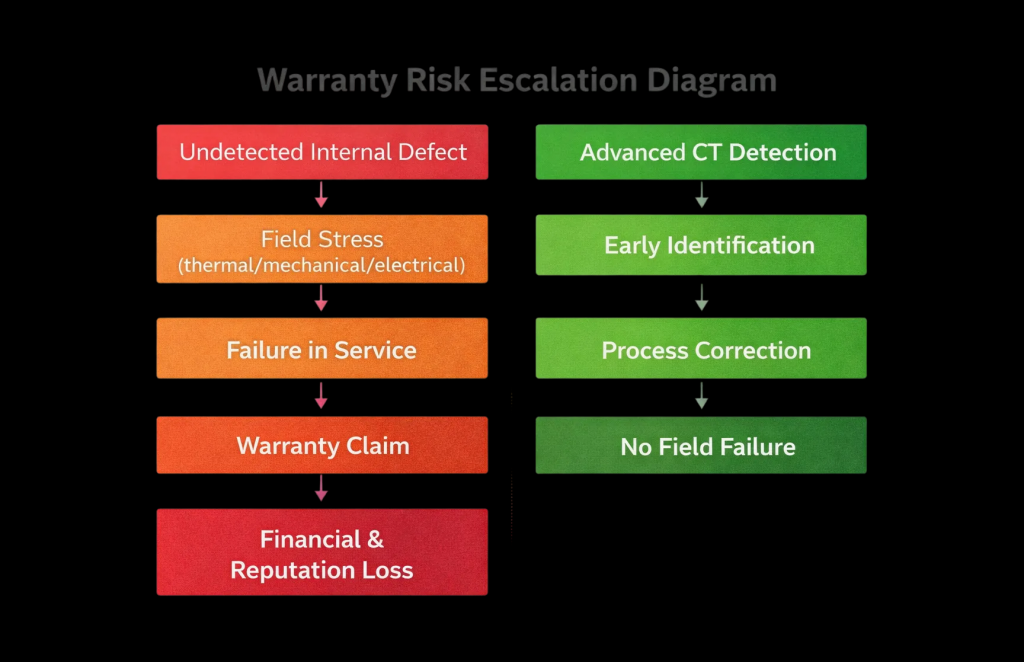
Warranty claims are more than a financial inconvenience. They are a signal of undetected internal defects, inspection gaps, or process inconsistencies.
For manufacturers of lithium-ion batteries, power electronics, cast components, and high-voltage assemblies, a single field failure can result in:
- Costly recalls
- Brand reputation damage
- Regulatory scrutiny
- Production disruptions
- Long-term customer trust erosion
In many cases, the root cause of these failures was present from the beginning — just invisible to conventional inspection systems.
This is where advanced X-ray and CT inspection changes the equation.
Table of Contents
Why Traditional Inspection Methods Miss Critical Defects
Many production lines rely on:
- Visual inspection
- Electrical testing
- 2D inline X-ray systems
- Sampling-based destructive testing
While these methods detect obvious issues, they often miss:
- Internal void clusters
- Layer misalignment in battery cells
- Sub-surface cracks
- Weld porosity
- Separator deformation
- Density inconsistencies
These defects may not cause immediate failure. Instead, they evolve under thermal, mechanical, or electrical stress — eventually surfacing as warranty claims months or years later.
By the time the issue is discovered, the financial and reputational damage is already done.
How Advanced X-ray & CT Inspection Prevents Field Failures
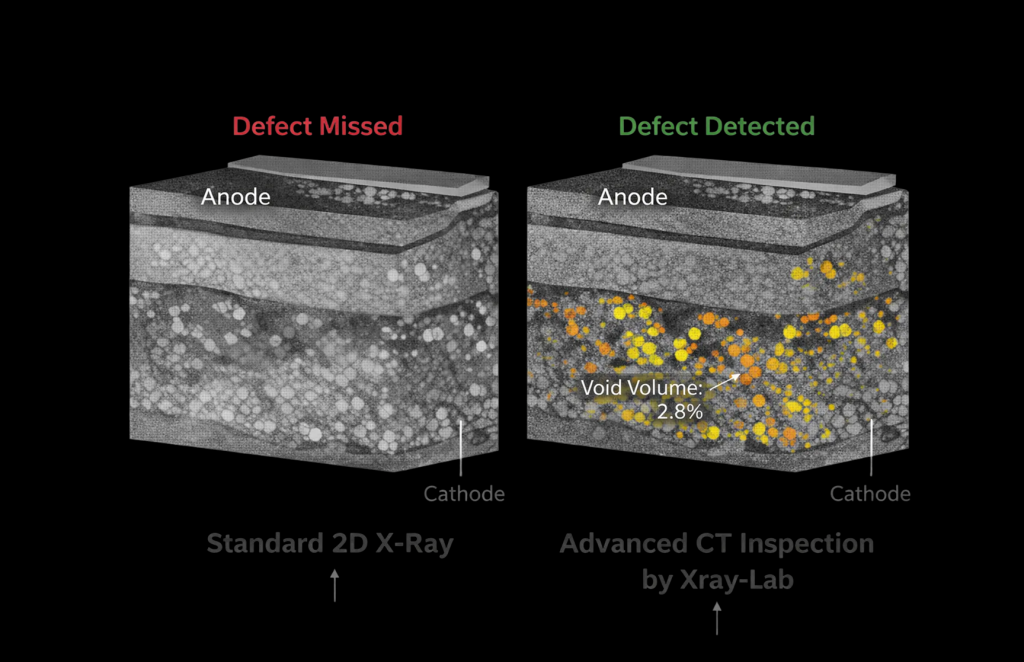
Advanced X-ray and computed tomography (CT) inspection provides full internal visibility — without destroying the component.
Unlike 2D imaging, CT reconstructs a complete 3D model of the product, allowing manufacturers to:
- Detect hidden structural defects
- Quantify porosity and void volume
- Analyze layer alignment across full assemblies
- Identify microcracks before propagation
- Evaluate weld integrity in detail
Instead of relying on assumptions, engineering teams gain measurable internal data.
Xray-Lab’s Approach to Reducing Warranty Risk
At Xray-Lab, inspection is not just about imaging. It is about aligning inspection strategy with real-world failure mechanisms.
Our approach includes:
1. Defect-Specific Scan Optimization
We adjust energy levels, resolution, geometry, and reconstruction parameters based on the defect type — not generic presets.
2. 3D Structural Analysis
Rather than reviewing isolated slices, we analyze full volumetric datasets to detect cumulative risk patterns.
3. Quantitative Defect Measurement
We move beyond “defect detected” to measurable metrics such as:
- Void percentage
- Cluster distribution
- Misalignment degree
- Crack length and propagation direction
4. Risk Mapping for High-Reliability Components
We correlate defect data with known stress zones to identify areas most likely to fail in service.
This transforms inspection from reactive quality control into proactive risk management.
Real Impact: From Cost Center to Competitive Advantage
Reducing warranty claims delivers measurable business benefits:
- Lower recall costs
- Reduced replacement expenses
- Improved production yield
- Stronger OEM relationships
- Increased product lifecycle reliability
More importantly, it builds confidence.
Manufacturers that invest in advanced inspection signal to partners and regulators that quality is engineered — not assumed.
Industries That Benefit Most
Advanced X-ray inspection is particularly critical for:
- Lithium-ion battery manufacturers
- EV component suppliers
- Power electronics producers
- Aerospace component manufacturers
- High-density cast part suppliers
- Sealed electronic assemblies
In high-risk applications, internal defects are not minor issues — they are safety concerns.
From Reactive Testing to Predictive Quality
Warranty claims often reveal what inspection missed.
Advanced CT inspection helps manufacturers shift from reacting to failures to predicting and preventing them.
Instead of discovering defects after shipment, teams gain internal structural certainty before products leave the factory.
That difference can define long-term competitiveness.
Conclusion
Xray Lab helps manufacturers significantly reduce warranty claims by providing advanced X-ray and 3D CT inspection services that identify hidden defects early in the production process. With high-resolution imaging and expert analysis, Xray Lab detects internal flaws that traditional methods may miss, enabling quality assurance teams to prevent failures before products reach customers. This proactive approach improves product reliability, minimizes costly recalls, and strengthens customer trust — making Xray Lab a valuable partner in reducing warranty risk.
Frequently Asked Questions
How does X-ray inspection reduce warranty claims?
Advanced X-ray and CT systems detect internal defects that traditional inspection methods cannot see. By identifying issues before products ship, manufacturers prevent failures that would otherwise result in warranty claims.
What types of defects are commonly linked to warranty issues?
Common hidden defects include void clusters, internal cracks, weld porosity, layer misalignment, separator deformation, and density inconsistencies in critical components.
Is CT inspection suitable for production environments?
Yes. While CT is often used for detailed analysis and validation, it can support production through sampling strategies, root cause investigations, and process optimization.
How is CT different from standard 2D X-ray inspection?
2D X-ray provides projection images, which can hide overlapping defects. CT reconstructs a full 3D volume, allowing precise localization, measurement, and segmentation of internal defects.
Can advanced inspection improve regulatory compliance?
Absolutely. Quantifiable defect data strengthens documentation, traceability, and quality assurance processes required by regulatory bodies.
