

Small mechanical components may appear insignificant, but in automotive, aerospace, medical devices, and electronics, they are critical to system performance. Tiny springs, fasteners, and micro-mechanical parts operate under high stress and tight tolerances, and even microscopic imperfections can compromise functionality or cause failures.
High-resolution X-ray inspection provides a precise, non-destructive method to analyze these parts. By visualizing internal structures at micron-level detail, manufacturers can detect cracks, inclusions, or slight deformations that would otherwise go unnoticed. Xray Lab, a leading NDT USA provider, offers advanced inspection services tailored for micro-mechanical components, ensuring both safety and reliability.
Table of Contents
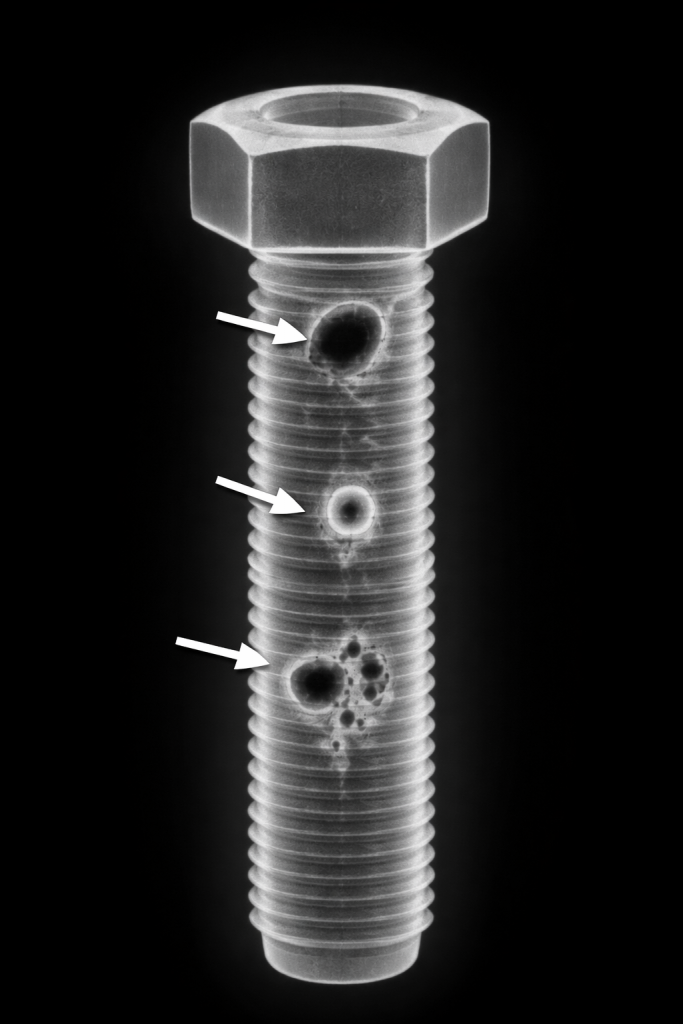
X-ray image of a bolt showing inclusions, voids, or internal density issues.
Precision Matters: Why Small Parts Require Advanced Inspection
Micro-mechanical parts often operate under extreme conditions, including high vibration, repeated loading, or thermal cycling. Even slight deviations in shape, density, or internal structure can significantly affect performance. For example, a spring with a hidden hairline crack may fail after just a few cycles, or a fastener with an internal inclusion may deform under stress, leading to assembly misalignment.
High-resolution X-ray provides insight into these issues, allowing manufacturers to verify production quality, maintain tight tolerances, and reduce the risk of failure in critical applications. Unlike visual inspection or simple mechanical testing, X-ray reveals the internal condition without altering or damaging the component.
How High-Resolution X-Ray Works
X-ray inspection produces detailed 2D images of micro-mechanical components, revealing cracks, voids, or inclusions. For complex or densely packed parts, CT scanning reconstructs a 3D model, providing volumetric insight into geometry, density variations, and potential weak points.
Specialized software can measure defect dimensions, evaluate severity, and generate actionable reports. This data helps manufacturers adjust production processes, optimize material use, and ensure each component meets rigorous design and safety specifications.
Advantages of X-Ray Inspection for Small Components
High-resolution X-ray inspection enables manufacturers to detect defects early, reduce scrap, and prevent assembly failures. It also allows verification of tight tolerances, evaluation of material consistency, and identification of manufacturing inconsistencies that can affect system performance.
In the USA, Xray Lab provides NDT services for micro-mechanical parts, combining advanced imaging with expert analysis to ensure every spring, fastener, and tiny mechanical component performs reliably in its intended application.
Frequently Asked Questions
How are defects detected in small mechanical parts?
High-resolution X-ray reveals internal cracks, inclusions, and deformations that are invisible externally.
Why is inspection critical for tiny components?
Even microscopic flaws can cause failures under repeated stress or in precision assemblies.
Can X-ray replace destructive testing?
Yes, it provides detailed, non-destructive evaluation while preserving part integrity.
Is NDT safe for delicate micro-mechanical parts?
Absolutely; X-ray and CT inspection do not alter or damage components.
Why choose Xray Lab for inspection in the USA?
Xray Lab combines state-of-the-art imaging with expert interpretation, ensuring reliability, quality, and compliance for critical small components.
