

Process-induced and assembly-related defects are among the most challenging failure modes to identify because they are typically not present in individual components. Instead, they emerge during joining, encapsulation, fastening, or under mechanical constraint. Conventional inspection often clears parts before assembly, allowing critical defects to form later and remain undetected until field failure.
Xray-Lab addresses this challenge through assembly-aware CT inspection strategies that evaluate how manufacturing forces, material flow, curing behavior, and constraint conditions alter internal structures after processing and integration.
Table of Contents
Defects Induced by Potting and Encapsulation Processes
Potting and encapsulation processes can introduce void migration, resin shrinkage, internal stress zones, and trapped air pockets that were not present prior to processing. These defects often develop during material flow and curing, making them highly process-dependent and difficult to predict using surface inspection or pre-potting analysis.
Xray-Lab applies post-process CT inspection to analyze internal structural changes caused by resin flow behavior, curing kinetics, and thermal shrinkage. This enables precise identification of newly formed voids and stress-prone regions within fully encapsulated assemblies.
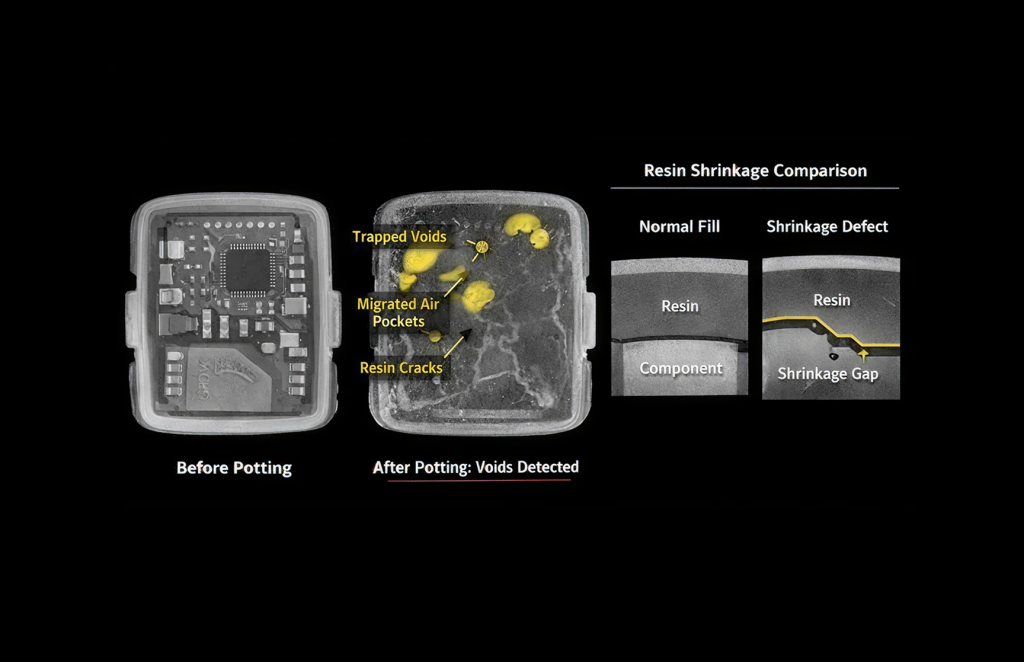
A reference CT scan captured before potting establishes the baseline internal condition. A second CT scan after potting highlights migrated voids and trapped air pockets using contrast-based segmentation. A cross-sectional comparison visualizes resin shrinkage zones and internal stress regions that form during curing, enabling direct correlation between process parameters and defect formation.
Assembly-Induced Micro-Cracking Under Mechanical Constraint
Mechanical joining operations such as press-fitting, fastening, or force-controlled assembly can introduce localized stress concentrations. These stresses often initiate micro-cracks at contact points, interfaces, or brittle material transitions, remaining invisible externally and frequently escaping inline inspection.
Xray-Lab performs assembly-level CT analysis by inspecting components in their final, mechanically constrained state. This approach reveals stress-induced damage that only manifests once parts are assembled and loaded as intended in real operating conditions.
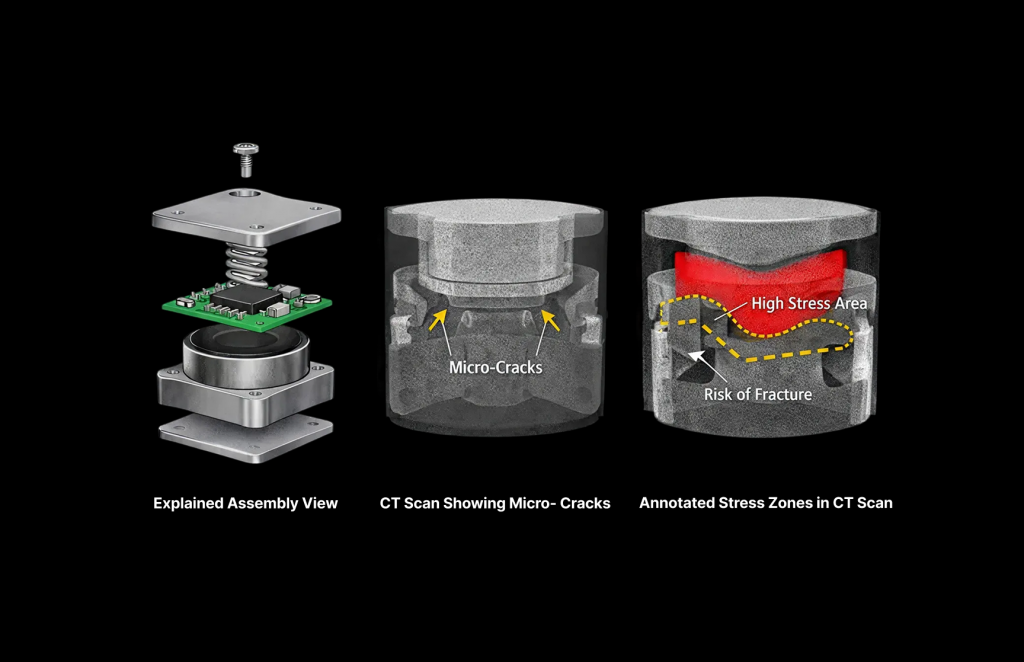
An exploded assembly view provides contextual understanding of load paths and contact interfaces. A high-resolution CT slice reveals micro-cracks originating precisely at stress concentration points. Annotated CT data highlights stress-critical regions directly on the scan, enabling engineers to link assembly forces to internal damage mechanisms.
Compression-Induced Density Variations in Polymer Components
Polymer components may develop internal density gradients due to excessive compression, clamping forces, or misaligned tooling during assembly. While these variations may not produce visible cracks, they can significantly reduce long-term mechanical stability and fatigue resistance.
Using density-sensitive CT evaluation, Xray-Lab detects subtle internal deformation patterns and density shifts that indicate over-compression or material displacement. This allows early identification of process deviations before functional failure occurs.
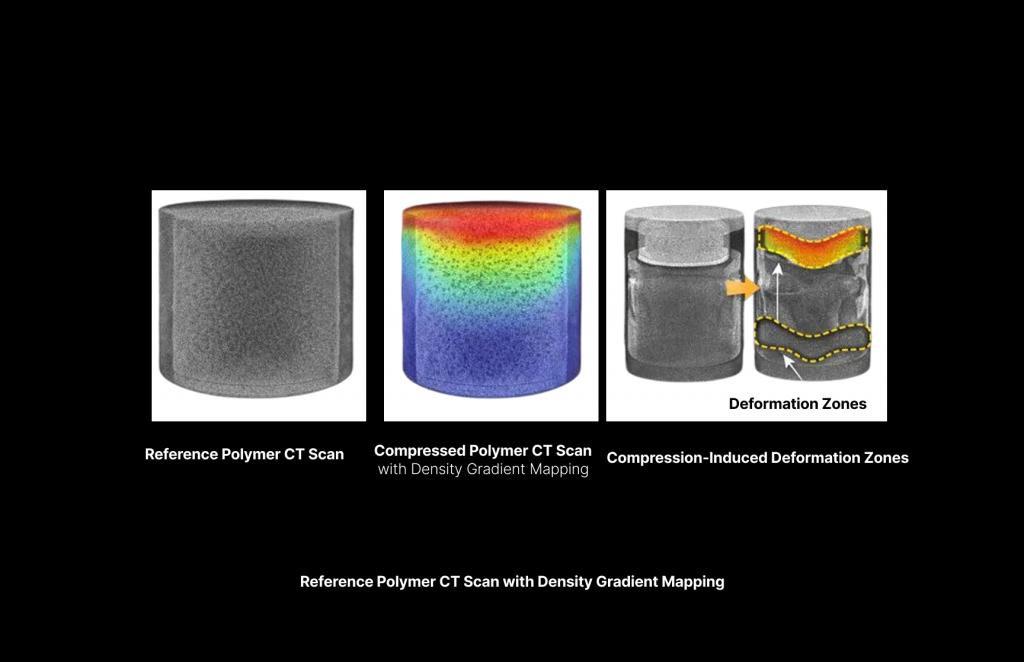
A reference polymer CT scan shows uniform material density under nominal conditions. A compressed polymer CT scan applies density gradient mapping to visualize internal compaction effects. A comparative visualization highlights deformation zones and density anomalies that correlate with excessive assembly forces.
Defect Evolution Across Sequential Manufacturing Stages
Certain defects are not static; they evolve as components pass through multiple manufacturing stages. Initial imperfections may grow, migrate, or interact with subsequent processes, accumulating stress and increasing failure risk over time.
Xray-Lab supports stage-specific inspection planning by scanning the same component at critical manufacturing milestones. This enables direct tracking of defect initiation, transformation, and growth across forming, assembly, and final integration stages.
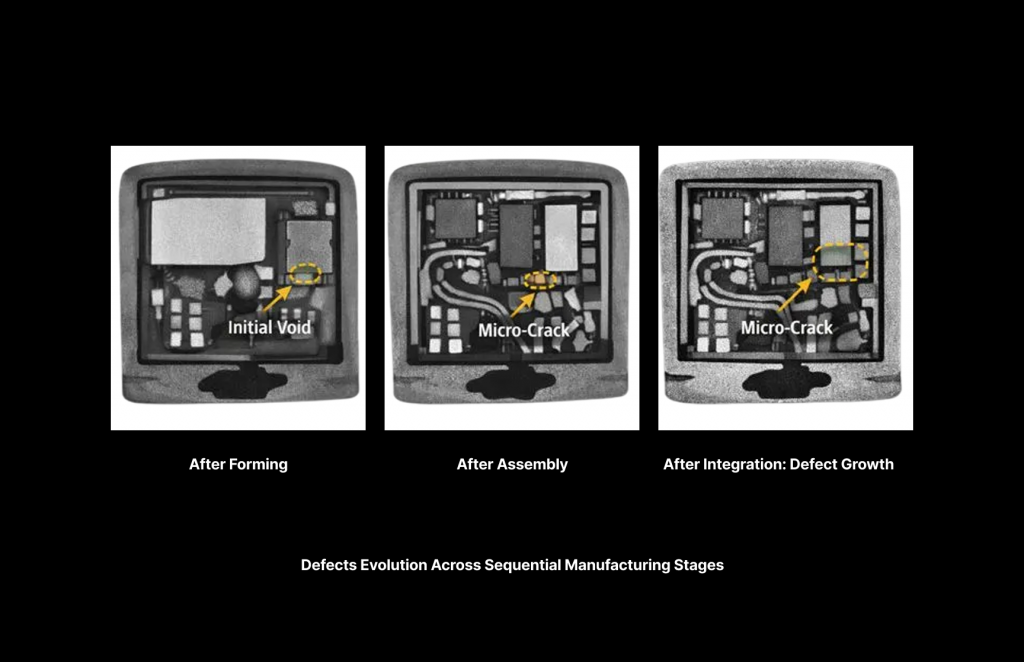
A CT scan after forming reveals initial internal features or minor imperfections. A CT scan after assembly shows the development of stress-related damage. A final CT scan after full integration highlights defect growth, crack propagation, or void expansion driven by cumulative processing effects.
Why Assembly-Aware Inspection Matters?
Inspecting components only in their unassembled state provides limited insight into real operating conditions. Xray-Lab’s process-oriented CT strategies enable the identification of defects introduced after component approval, accurate assessment of load- and constraint-driven failure risks, and a significant reduction in latent field failures caused by assembly effects.
Frequently Asked Questions
Why are assembly-related defects difficult to detect using conventional inspection?
Because many defects form only after joining or under mechanical constraint, they are not present during pre-assembly inspection and remain hidden beneath encapsulation or housing structures.
Can CT inspection identify defects caused purely by manufacturing forces rather than material flaws?
Yes. Xray-Lab’s CT analysis focuses on stress distribution, material displacement, and density variation, allowing detection of force-induced defects even when material quality is otherwise acceptable.
Is post-process CT inspection suitable for fully assembled products?
Absolutely. Xray-Lab specializes in non-destructive inspection of fully assembled and encapsulated components without requiring disassembly or sectioning.
Can defect evolution be tracked across multiple production stages?
Yes. Stage-specific CT inspection allows the same component to be scanned at different manufacturing steps, providing direct insight into how defects initiate and grow.
Does Xray-Lab offer sample analysis before full inspection programs?
Xray-Lab offers a free initial sample analysis for selected components to assess process- and assembly-related defect risks.
Conclusion
Process-induced and assembly-related defects represent a critical blind spot in conventional inspection strategies. By focusing solely on individual components, manufacturers risk overlooking defects that only emerge under real assembly and operating conditions. Xray-Lab’s assembly-aware CT inspection approach bridges this gap by revealing how processes, forces, and constraints interact internally across the full manufacturing lifecycle. This enables earlier intervention, improved process control, and greater long-term product reliability.
