

Internal short circuits are among the most critical failure modes in lithium-ion batteries and high-density electronic assemblies. Unlike external failures, they occur inside sealed components — often without warning.
In battery systems, an internal short can lead to:
- Rapid heat generation
- Thermal runaway
- Fire or explosion risk
- Sudden performance collapse
In electronics, it can result in overheating, irreversible damage, or complete device failure.
Most internal shorts originate from structural defects introduced during manufacturing. The challenge is simple: you cannot prevent what you cannot see.
Table of Contents
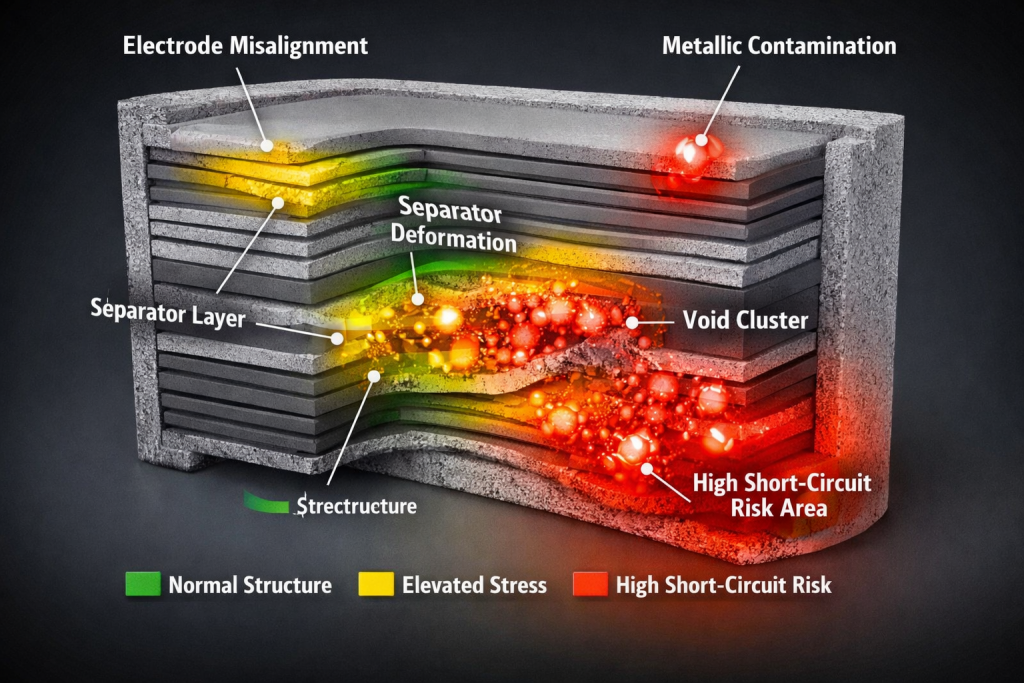
3D CT Risk Mapping of Internal Short-Circuit Triggers in a Lithium-Ion Battery Cell
Advanced CT inspection visualizes misalignment, separator deformation, contamination, and void clustering — before electrical failure occurs.
What Causes Internal Short Circuits?
Internal short circuits occur when conductive elements that should remain electrically isolated come into contact. The most common structural triggers include:
- Electrode misalignment
- Separator deformation or thinning
- Metallic particle contamination
- Dendrite growth risk zones
- Weld spatter or internal debris
- Compression-induced layer displacement
These defects are often microscopic and deeply embedded within sealed components. Many pass electrical testing at the factory but fail later under thermal cycling, vibration, or mechanical stress.
Why Traditional Inspection Methods Miss the Risk
Conventional inspection tools have structural limitations:
- Visual inspection cannot access internal layers.
- Electrical testing detects active shorts, not potential ones.
- 2D X-ray imaging compresses complex 3D structures into flat projections.
- Destructive testing relies on sampling and cannot represent full production variability.
As a result, latent internal weaknesses remain invisible until they escalate into field failures.
How CT Scanning Prevents Internal Short Circuits
Computed tomography (CT) scanning reconstructs a complete 3D model of a component’s internal architecture. This enables engineers to detect structural conditions that can evolve into short circuits.
1. Detecting Electrode Misalignment
CT maps electrode alignment across the full height of a battery cell. Even subtle offsets that increase local current density can be identified and measured before they create high-risk zones.
2. Identifying Separator Deformation
Buckling, thinning, or compression of separators reduces insulation between electrodes. CT cross-sections isolate separator integrity and highlight deformation regions with high precision.
3. Revealing Metallic Contamination
Foreign conductive particles trapped inside cells are a major short-circuit trigger. High-resolution CT can detect internal metallic inclusions that standard inspection methods often miss.
4. Mapping Void Clusters and Stress Zones
Void clusters concentrate stress and accelerate degradation. Advanced CT segmentation tools visualize density variations and clustering behavior that contribute to structural instability.
From Detection to Prevention
CT scanning supports prevention strategies by enabling:
- Process optimization for stacking and winding
- Improved contamination control
- Separator material validation
- Weld integrity verification
- Structural stress-zone analysis
Inspection becomes aligned with real failure mechanisms rather than surface-level quality checks.
Conclusion
Internal short circuits are rarely sudden or unpredictable events. They are the outcome of structural imperfections introduced during manufacturing — imperfections that remain hidden until mechanical, thermal, or electrical stress exposes them.
Traditional inspection methods often detect problems only after failure occurs. CT scanning changes that approach by providing full 3D visibility into internal structures, allowing manufacturers to identify electrode misalignment, separator deformation, metallic contamination, and void clustering before they evolve into critical safety incidents.
At Xray-Lab, CT inspection is engineered around real-world failure mechanisms. By combining high-resolution scanning with quantitative structural analysis, Xray-Lab helps manufacturers detect latent risks early, reduce warranty exposure, strengthen compliance, and improve long-term product reliability.
In high-risk industries such as EV batteries and power electronics, prevention begins with visibility. And visibility begins with advanced CT inspection designed to eliminate blind spots before they become failures.
Frequently Asked Questions
Can CT scanning detect defects before a short circuit occurs?
Yes. CT scanning identifies structural irregularities such as misalignment, contamination, and separator deformation before they evolve into active electrical shorts.
Is CT scanning destructive?
No. Industrial CT is a non-destructive testing method that allows full internal analysis without damaging the component.
How is CT different from standard 2D X-ray?
CT reconstructs a full 3D model of internal structures, while 2D X-ray compresses everything into a flat image, which can hide overlapping defects.
Can CT be used for production-level inspection?
Yes. CT can support sampling strategies, failure analysis, process validation, and in some cases automated inline inspection, depending on system configuration.
What industries benefit most from CT-based short-circuit prevention?
Industries such as electric vehicle battery manufacturing, consumer electronics, aerospace electronics, and power systems benefit significantly due to high reliability and safety requirements.
