

Porosity refers to the presence of internal voids, gas pockets, or inclusions formed during manufacturing processes such as casting, injection molding, or additive manufacturing. These discontinuities are rarely visible from the outside, yet they directly influence how a component performs under real operating conditions. In many cases, porosity remains undetected until it leads to leakage, reduced strength, or early-stage failure.
Table of Contents
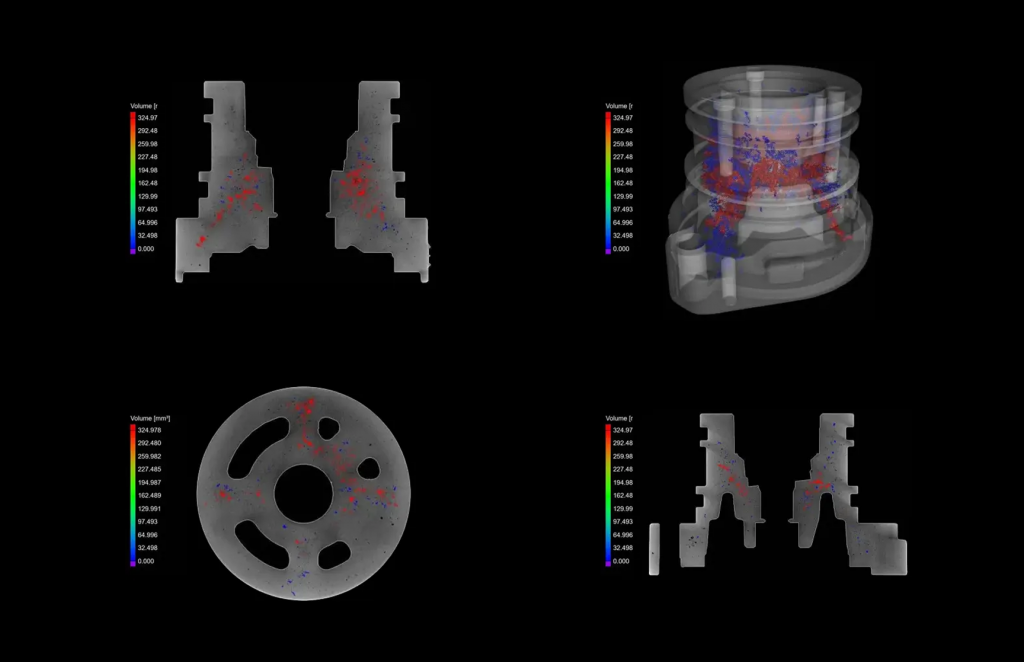
3D CT visualization highlighting internal porosity distribution across different components using color-mapped volumetric analysis.
Limitations of Surface and Sectional Inspection
Porosity is inherently a three-dimensional defect, and evaluating it through surface inspection or limited cross-sections often provides an incomplete picture. What matters is not just the presence of voids, but their size, distribution, and proximity to critical regions.
Computed Tomography (CT) addresses this by reconstructing a full volumetric dataset, allowing engineers to work with measurable internal data rather than assumptions. This approach aligns closely with the principles discussed in
👉 https://xray-lab.com/en/how-ai-and-industrial-tomography-are-transforming-quality-inspection/ where CT is positioned as a key tool for data-driven inspection.
Industrial Applications of Porosity Analysis
In cast components, porosity typically develops due to shrinkage effects or entrapped gases during solidification. CT analysis makes it possible to evaluate how these voids are distributed within load-bearing zones, helping prevent structural weaknesses. A deeper look at this can be found in
👉 https://xray-lab.com/en/ct-scanning-automotive-castings-defect-prevention/
In additive manufacturing, porosity often appears as lack-of-fusion defects or micro-voids between layers. Since these structures are inherently complex, CT provides a reliable way to verify internal integrity without destroying the part, supporting advanced inspection workflows highlighted across your CT-focused content.
For injection-molded plastics, porosity is usually linked to air entrapment or irregular material flow. CT helps identify these voids and correlate them with processing conditions. This is closely related to
👉 https://xray-lab.com/en/industrial-ct-molded-plastic-wall-thickness-voids-warping/
In battery and e-mobility applications, porosity within electrodes or welded connections can affect both performance and safety. CT enables detailed inspection of these internal features, as explored in
👉 https://xray-lab.com/en/x-ray-and-ct-for-battery-cell-safety-testing/
Xray Lab Approach to Porosity Evaluation
At Xray Lab, porosity analysis goes beyond simple defect detection. The focus is on generating volumetric data that can be directly interpreted within engineering and quality workflows.
High-resolution CT systems are used to capture internal structures and evaluate porosity in terms of volume, distribution, and location relative to functional regions. This allows engineers to understand not just where defects exist, but how they may influence performance.
By combining inspection with analysis, Xray Lab supports faster validation cycles, more informed decision-making, and improved process control—especially in applications where internal integrity is critical.
Conclusion
Porosity is a volumetric defect that cannot be fully understood through surface inspection alone. Its impact depends on how it is distributed within a component and how it interacts with surrounding material.
CT-based analysis provides a complete internal perspective, enabling precise detection and evaluation. For manufacturers working with complex or high-performance components, this level of insight is essential for improving reliability and maintaining consistent quality.
Frequently Asked Questions
What is porosity in manufacturing?
Porosity refers to small voids or air pockets within a material, usually formed during manufacturing processes like casting, molding, or 3D printing. These voids can affect strength, durability, and performance.
Why is porosity difficult to detect?
Porosity is typically internal and not visible from the surface. Traditional inspection methods often miss it or provide only limited information, making volumetric techniques like CT necessary.
How does CT scanning detect porosity?
CT scanning captures multiple X-ray projections and reconstructs a 3D model of the component. This allows internal voids to be detected, measured, and analyzed without cutting the part.
Which industries benefit most from porosity analysis?
Industries such as automotive, aerospace, electronics, additive manufacturing, and e-mobility benefit significantly, especially where internal integrity is critical.
Can porosity be quantified using CT?
Yes, CT allows porosity to be quantified in terms of size, volume, and distribution, enabling detailed engineering analysis and process improvement.
