

Glass is often seen as delicate yet transparent, but technical and industrial glass plays a critical role in high-performance systems. From electronic displays and optical instruments to industrial enclosures and chemical-resistant panels, even small internal defects can undermine performance and reliability.
Non-Destructive Testing (NDT) using X-ray and CT scanning provides a solution for identifying hidden anomalies—cracks, inclusions, or variations in thickness—without compromising the glass component itself.
Xray Lab delivers precision inspection services for glass components, helping manufacturers ensure internal integrity and consistent quality in demanding applications.
Table of Contents
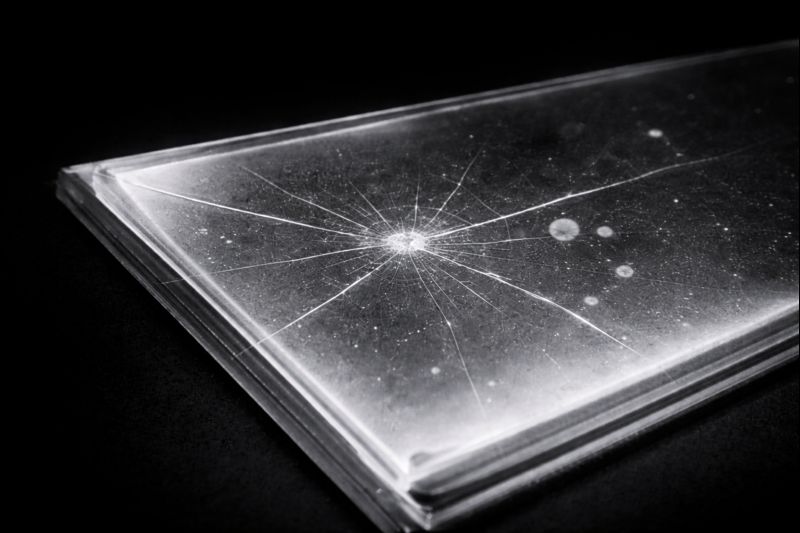
X-ray radiographic image of an industrial glass component revealing internal micro-cracks and density variations that are not visible during visual inspection.
The Hidden Vulnerabilities of Industrial Glass
Despite its clarity, glass is highly susceptible to internal flaws that are not visible on the surface. Micro-cracks, gas bubbles, or uneven thickness can form during manufacturing, thermal cycling, or mechanical handling. These hidden imperfections may cause:
- Premature mechanical failure under stress
- Optical distortion in lenses and displays
- Reduced chemical resistance in industrial panels
Without advanced inspection techniques, these issues can go unnoticed until failure occurs, often resulting in costly repairs, product recalls, or downtime in industrial systems.
How NDT Reveals Hidden Glass Defects
X-ray and CT inspection offer unparalleled insight into the internal structure of glass.
- X-ray Imaging: Quickly reveals internal cracks, bubbles, and foreign inclusions. Even micro-defects that affect optical performance can be identified.
- CT Scanning: Provides a 3D reconstruction of the component, mapping internal geometry, thickness variations, and hidden anomalies. This is essential for precision applications such as optics or display panels.
- Data Analysis: Inspection data is processed with advanced software to quantify defects, measure wall thickness, and generate actionable reports for quality assurance and process improvement.
Why NDT is Critical for Industrial Glass
Glass used in industrial and technical applications often operates under demanding conditions. Thermal expansion, mechanical loads, and chemical exposure can amplify the effect of small flaws. By performing NDT early in the production or assembly process, manufacturers can:
- Detect micro-cracks and inclusions before they propagate
- Ensure thickness consistency and dimensional accuracy
- Prevent costly product failures or warranty claims
- Improve confidence in long-term component reliability
Xray Lab supports these outcomes by providing state-of-the-art X-ray and CT inspection services that reveal internal glass defects with unmatched accuracy, safeguarding performance across technical and industrial systems.
Frequently Asked Questions
Which types of glass are suitable for NDT inspection?
Technical and industrial glass, including lenses, optical panels, sensor covers, display screens, and protective enclosures.
Can micro-cracks in glass be detected reliably?
Yes, high-resolution X-ray and CT scanning detect even microscopic cracks that may compromise performance.
How does CT scanning improve inspection for glass components?
CT scanning produces a 3D model that allows precise measurement of thickness, mapping of inclusions, and localization of cracks.
Is NDT safe for delicate or thin glass components?
Yes, inspection is entirely non-destructive and does not alter structural or optical properties.
How does Xray Lab ensure accurate defect detection?
By combining advanced imaging systems, optimized scanning parameters, and expert analysis to deliver precise, actionable inspection results.
