

In modern manufacturing, quality inspection is no longer just a final checkpoint before shipment. It has evolved into a strategic risk management tool that helps manufacturers prevent failures, avoid costly recalls, and maintain product reliability.
This shift is especially important in industries such as automotive, aerospace, electronics, and energy, where hidden defects inside components can lead to major operational or safety risks.
Through advanced industrial X-ray and computed tomography (CT) technologies, XRAY-LAB approaches inspection not as a reactive activity but as an engineering-driven risk mitigation process. By enabling engineers to visualize internal structures without destroying the component, inspection becomes a way to identify potential failures long before they reach the field.
Table of Contents
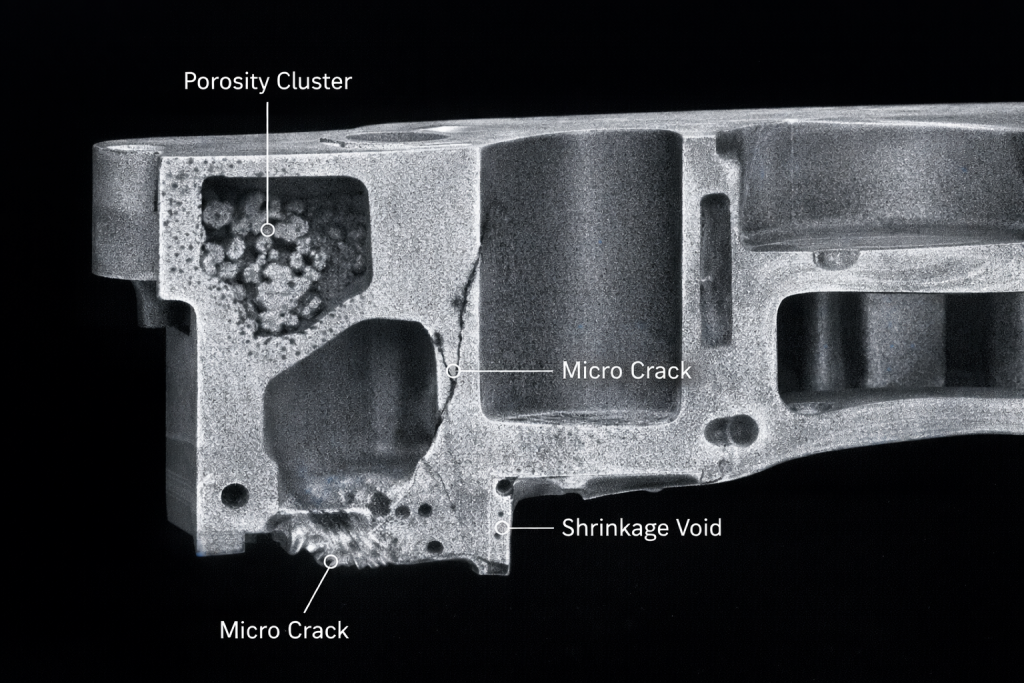
Engineering Insights from Industrial CT Analysis
Why Inspection Is Fundamentally a Risk Management Strategy?
Manufacturing defects are not always visible on the surface. Internal cracks, voids, incomplete solder joints, bonding defects, or material inconsistencies can remain hidden until the component fails during operation.
From a risk management perspective, these defects can lead to:
- Product failures in the field
- Warranty claims and recalls
- Production downtime
- Safety hazards
- Loss of brand reputation
Non-destructive inspection technologies provide a powerful solution because they allow manufacturers to detect internal defects early, reducing the probability of these risks materializing.
Modern inspection therefore serves three critical purposes:
- Risk Prevention – Identifying defects before they propagate into failures.
- Risk Assessment – Understanding how a defect affects structural integrity.
- Risk Mitigation – Adjusting design, materials, or production processes to eliminate recurring problems.
This perspective transforms inspection from a routine quality check into a strategic engineering tool for decision-making.
XRAY-LAB’s Engineering-Driven Inspection Approach
Rather than treating inspection as a standalone testing step, XRAY-LAB integrates inspection into a broader engineering and quality framework.
Their approach combines advanced imaging technology, engineering analysis, and process insights.
1. Non-Destructive Internal Visibility
Industrial X-ray and CT scanning provide detailed insight into the internal structure of components. In CT inspection, the object is rotated while thousands of X-ray images are captured and reconstructed into a complete 3D volumetric model, allowing engineers to examine internal features and defects without damaging the part.
This makes it possible to analyze:
- Internal porosity and voids
- Cracks and fracture origins
- Misaligned assemblies
- Material inclusions
- Bonding defects in multi-material components
Because the inspection is non-destructive, the same component can continue through further testing or production analysis.
2. Engineering-Level Defect Analysis
Inspection data alone does not solve a problem. The real value comes from interpreting the data through engineering analysis.
XRAY-LAB focuses on identifying:
- The root cause of defects
- The impact of defects on product performance
- Whether the defect is critical or acceptable within tolerance
For example, the same void inside a component may cause immediate failure in one product but remain harmless in another depending on stress conditions and material behavior. Understanding this distinction helps manufacturers prioritize corrective actions effectively.
3. Supporting Process Optimization
Inspection results can reveal patterns that point directly to manufacturing issues.
For instance, repeated defects detected in CT scans may indicate:
- Incorrect injection molding parameters
- Welding inconsistencies
- Material contamination
- Improper bonding processes
By connecting inspection results with production processes, manufacturers can optimize manufacturing parameters and reduce defect occurrence over time.
How XRAY-LAB Helps Manufacturers Manage Risk
The engineering approach used by XRAY-LAB enables manufacturers to turn inspection into a proactive risk control mechanism.
Early Detection of Hidden Defects: X-ray and CT inspection reveal internal defects that conventional visual inspection cannot detect, helping manufacturers identify potential failures before products leave the factory.
Root Cause Failure Investigations: When a component fails, CT data allows engineers to analyze fracture origins, crack propagation, and internal structural weaknesses.
Verification of Complex Assemblies: Many modern products involve multi-material assemblies or sealed components that cannot be disassembled. X-ray inspection allows engineers to verify internal assembly quality without destroying the part.
Support for Design Validation: Engineering teams can use CT data to evaluate prototypes, optimize designs, and validate manufacturing methods before full-scale production.
Industries That Benefit from Inspection-Driven Risk Management
XRAY-LAB’s inspection technologies support a wide range of industries where reliability is critical.
Examples include:
- Automotive – battery cells, power electronics, cast components
- Aerospace – composite structures, turbine components, honeycomb panels
- Electronics – PCB assemblies, solder joints, microelectronics
- Energy systems – turbines, power modules, structural components
- Industrial manufacturing – castings, sintered metals, molded plastics
In each of these sectors, inspection provides the information necessary to anticipate risks before they become operational failures.
The Future of Risk-Focused Inspection
Manufacturing is becoming increasingly complex, with multi-material assemblies, advanced composites, and high-density electronics.
As a result, traditional inspection methods are no longer sufficient to guarantee reliability.
The future of inspection is moving toward:
- 3D CT inspection for deeper structural insights
- AI-assisted defect detection
- Inline inspection systems for real-time production monitoring
- Data-driven quality engineering
Organizations that adopt inspection as a risk management strategy rather than a compliance step will be better positioned to prevent failures and maintain product quality.
Conclusion
Inspection is no longer simply about checking whether a product meets specifications. It is about understanding and managing the risks that defects pose to performance, safety, and reliability.
Through advanced X-ray and CT technologies combined with engineering expertise, XRAY-LAB helps manufacturers move from reactive quality control to proactive risk management.
By detecting hidden defects, analyzing root causes, and supporting process optimization, inspection becomes a powerful tool that protects both product integrity and business reputation
Frequently Asked Questions
What does inspection as risk management mean in manufacturing?
Inspection as risk management means using testing and analysis methods to identify potential defects early and reduce the likelihood of product failure, recalls, or safety incidents.
How does X-ray inspection help manage manufacturing risks?
X-ray inspection allows engineers to see inside components and detect hidden defects such as cracks, voids, and misalignments without destroying the part.
What is the advantage of CT scanning compared to traditional inspection?
Computed tomography (CT) produces a full 3D representation of a component’s internal structure, enabling engineers to analyze defects, material distribution, and structural integrity in detail.
Can CT inspection help with failure investigations?
Yes. CT scanning allows engineers to trace crack initiation points, analyze fracture paths, and identify the root cause of failures without damaging the sample.
Which industries benefit most from industrial X-ray inspection?
Industries such as automotive, aerospace, electronics, and energy rely heavily on X-ray and CT inspection because even small internal defects can cause major reliability or safety problems.
