

Failures in manufactured products rarely originate from visible surface defects. In many cases, the actual cause lies inside the component—hidden in internal cracks, voids, misalignment, or structural inconsistencies that conventional inspection methods cannot detect.
When a failure occurs, manufacturers must quickly determine the root cause to prevent repeated defects, production losses, or warranty claims. However, traditional failure analysis methods often require destructive testing, which can be time-consuming and may even eliminate valuable evidence.
XRAY LAB helps accelerate root cause failure investigations using industrial CT scanning, allowing engineers to visualize the complete internal structure of failed components without cutting them open. This approach provides faster, clearer insights into failure mechanisms and supports data-driven corrective actions.
Table of Contents
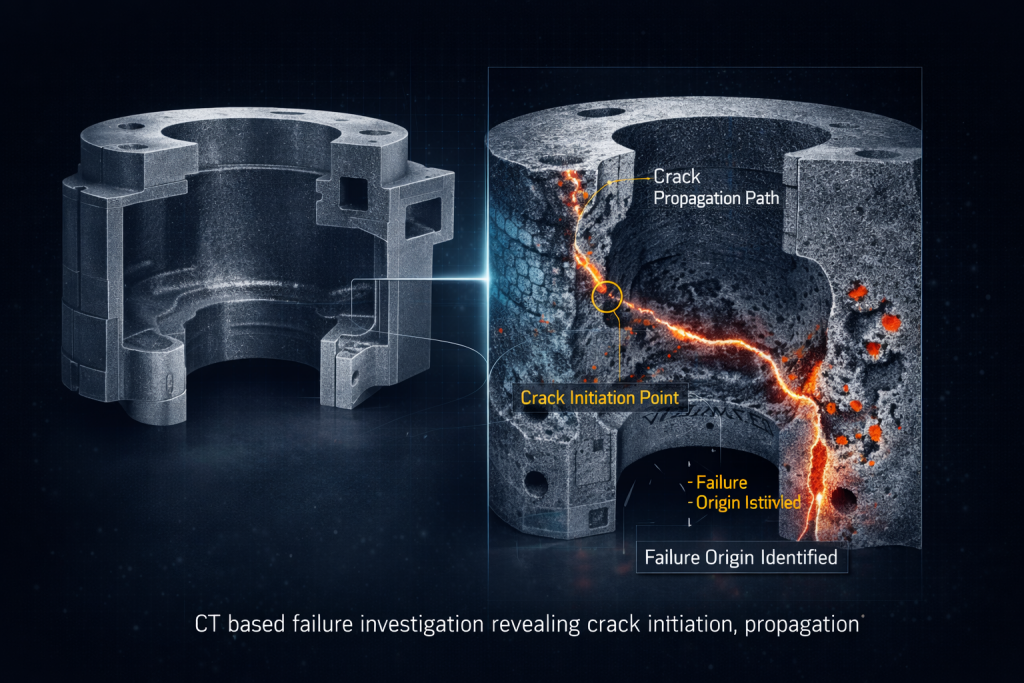
Industrial CT cross-section used by XRAY LAB to identify the root cause of structural failure through crack origin detection and internal defect analysis.
Why Root Cause Analysis Often Becomes Complex
When a component fails, the cause is rarely obvious. Surface inspection may reveal damage, but it often does not explain why the failure occurred.
Common hidden causes include:
- Internal cracks initiated during manufacturing
- Porosity clusters weakening structural areas
- Misaligned internal components
- Material density variations
- Assembly-induced stress concentrations
Traditional investigation methods typically involve cutting the component into sections to analyze internal structures. While useful, destructive analysis introduces limitations:
- The component cannot be reused for further testing
- Critical failure zones may be missed during sectioning
- The investigation process becomes slow and resource-intensive
XRAY LAB solves these challenges by enabling full internal inspection before any destructive testing is performed.
How CT Scanning Reveals the True Failure Mechanism
Industrial CT scanning captures hundreds or thousands of X-ray projections around a component. These projections are reconstructed into a detailed 3D volumetric model that reveals internal structures with high precision.
This allows engineers to analyze the component internally without damaging it.
Using CT scanning, XRAY LAB enables:
- Cross-sectional inspection at any location
- Visualization of cracks, voids, and inclusions
- Identification of structural deformation
- Analysis of internal assembly relationships
Because the entire component is reconstructed in 3D, investigators can examine the exact origin of the failure rather than relying on assumptions.
Identifying Crack Initiation and Propagation
Cracks are one of the most common causes of structural failure. However, the origin of a crack is often extremely small and hidden deep inside the material.
XRAY LAB uses high-resolution CT scanning to trace crack initiation points and understand how the crack propagated through the structure.
This allows investigators to determine whether the failure was caused by:
- Material defects
- Manufacturing inconsistencies
- Design weaknesses
- Assembly stresses
- Operational fatigue
By identifying the exact starting point of the crack, engineers can implement targeted corrective actions instead of broad process adjustments.
Detecting Hidden Porosity and Structural Weakness
Internal porosity is another common contributor to product failure. Porosity can reduce mechanical strength, create stress concentration zones, and accelerate fatigue.
XRAY LAB performs detailed porosity analysis using CT scanning to:
- Measure total void volume
- Map porosity distribution
- Identify critical void clusters near load-bearing areas
This quantitative analysis helps determine whether manufacturing processes such as casting or molding introduced structural weaknesses that contributed to failure.
Evaluating Assembly and Component Interactions
In many cases, failures are not caused by a single component defect but by interactions between multiple assembled parts.
XRAY LAB uses CT scanning to inspect fully assembled systems and analyze:
- Misalignment between components
- Improper fit or clearance issues
- Internal deformation caused by fastening or press-fitting
- Structural interference between parts
Because CT scanning captures the entire assembly, engineers gain insight into how components interact under real conditions.
Faster Investigations and Data-Driven Decisions
Speed is critical in failure investigations. Production lines, customer deliveries, and quality assurance processes depend on quickly identifying the cause of defects.
XRAY LAB accelerates root cause analysis by providing:
- Rapid non-destructive internal inspection
- High-resolution 3D visualization
- Quantifiable defect measurements
- Structured engineering reports
Instead of relying on trial-and-error destructive testing, manufacturers receive precise data that helps identify the true cause of failure.
Conclusion: How XRAY LAB Supports Faster Failure Resolution
Effective root cause analysis requires more than visual inspection or assumptions. Hidden internal defects often drive product failures, and identifying them quickly is essential for preventing recurrence.
XRAY LAB enables manufacturers to investigate failures with speed, precision, and complete internal visibility.
Through advanced industrial CT scanning, XRAY LAB provides detailed 3D reconstruction, crack analysis, porosity quantification, and assembly evaluation. These capabilities allow engineering teams to pinpoint the origin of failures, implement targeted corrective actions, and strengthen overall product reliability.
By accelerating failure investigations and delivering measurable insights, XRAY LAB helps manufacturers move from reactive troubleshooting to proactive quality improvement.
Frequently Asked Questions
What is CT scanning in failure analysis?
CT scanning is a non-destructive inspection technique that creates a detailed 3D model of a component’s internal structure. It allows engineers to identify hidden defects that may have caused product failure.
How does CT scanning accelerate root cause investigations?
CT scanning eliminates the need for immediate destructive testing and provides instant internal visibility. Engineers can analyze defects quickly and identify failure mechanisms more efficiently.
What types of failures can XRAY LAB investigate?
XRAY LAB can analyze failures caused by cracks, porosity, internal misalignment, material defects, assembly issues, and structural deformation.
Can CT scanning analyze fully assembled components?
Yes. XRAY LAB can scan fully assembled products, allowing engineers to evaluate internal component interactions and identify assembly-related failure causes.
When should CT scanning be used in a failure investigation?
CT scanning is most valuable during early-stage failure investigations, when the cause of the defect is unknown and non-destructive internal analysis can provide rapid insights.
