

Lithium-ion battery cells are among the most safety-critical components in modern manufacturing. Many of their most dangerous failure modes are latent—hidden deep within the cell structure and undetectable through surface inspection or standard inline X-ray checks.
At Xray-Lab, we use high-resolution computed tomography (CT) to analyze internal structure and alignment, identifying defects that can later evolve into thermal runaway, capacity loss, or premature cell failure.
Table of Contents
Why Latent Defects in Battery Cells Are So Dangerous
Unlike visible manufacturing defects, latent internal defects may not impact initial performance. Instead, they worsen over time due to:
- Repeated charge–discharge cycles
- Thermal expansion
- Mechanical stress during module assembly
By the time failure becomes apparent, the root cause is often already embedded inside the cell.
CT inspection enables non-destructive access to these internal risk factors—before they escalate.
Common Latent Defects Detected by CT Inspection
Electrode Misalignment: Misaligned anode and cathode layers reduce effective active area and increase localized current density. Over time, this can lead to:
- Hot spots
- Accelerated aging
- Internal short circuits
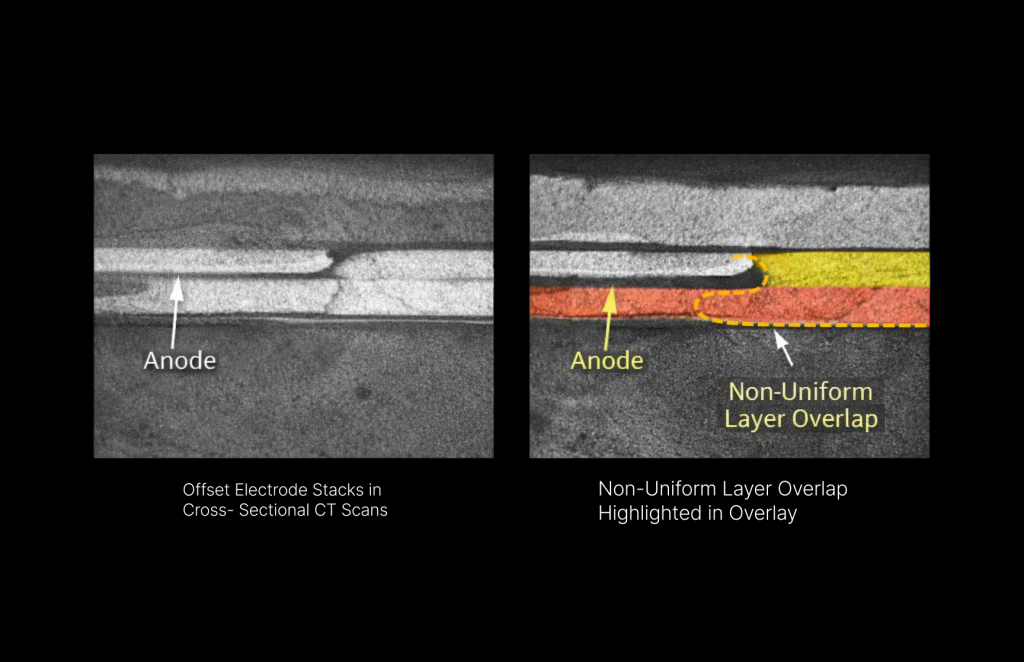
CT cross-sections showing offset electrode stacks, Overlay highlighting non-uniform layer overlap
Separator Deformation: The separator is the last internal safety barrier. Compression, wrinkling, or deformation can severely reduce its insulating effectiveness.
These defects often result from:
- Winding tension variation
- Mechanical constraint during cell insertion
- Thermal stress during formation
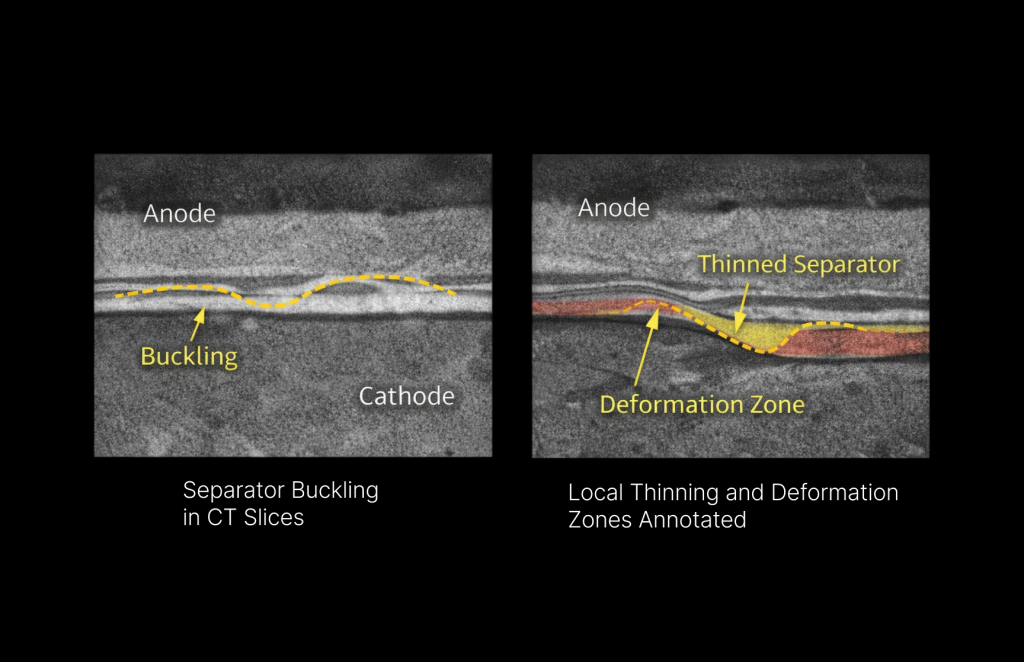
CT slices revealing separator buckling, Local thinning and deformation zones annotated
Internal Void Clusters: Void clusters can form within electrode coatings or electrolyte-filled regions due to incomplete wetting, trapped gas, or process instability.
Although small individually, clustered voids can:
- Increase internal resistance
- Promote lithium plating
- Accelerate localized degradation
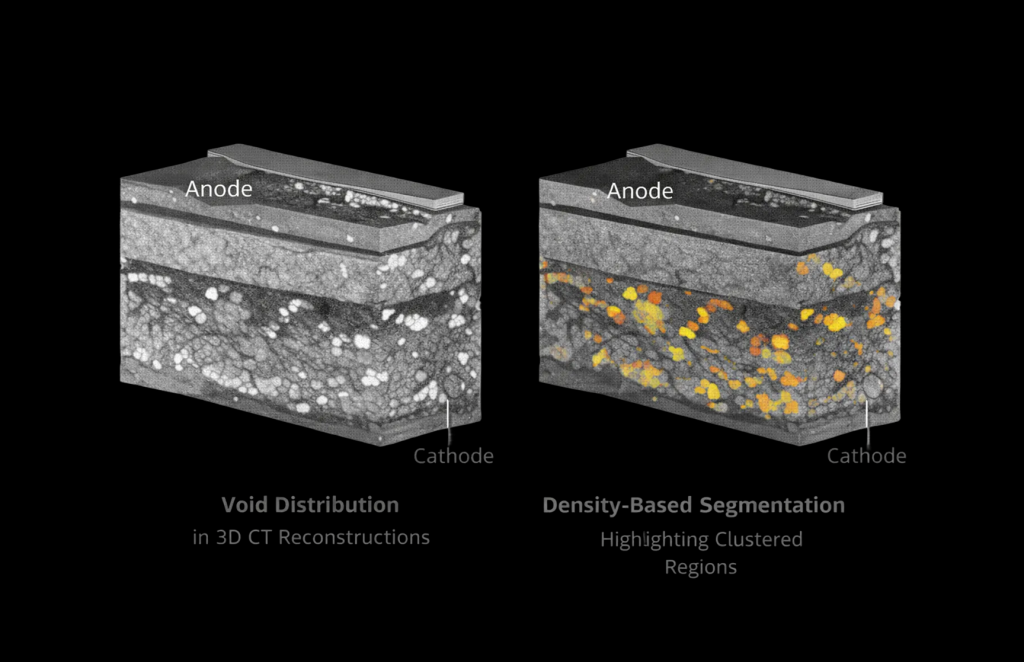
3D CT reconstructions showing void distribution, Density-based segmentation highlighting clustered regions
Xray-Lab’s Solution: Internal Structure and Alignment Analysis
Xray-Lab applies battery-specific CT methodologies tailored to high-risk components. Our approach focuses on:
- Sub-micron resolution for layered structures
- Density-sensitive reconstruction for separator and electrolyte regions
- Quantitative alignment metrics across electrode stacks
Rather than simply visualizing defects, we measure structural deviations and relate them directly to known failure mechanisms.
Why CT Is Essential for Battery Safety
Traditional inline X-ray inspection is limited by:
- Projection overlap in layered structures
- Insufficient sensitivity to separator deformation
- Inability to quantify 3D defect progression
CT overcomes these limitations by providing true volumetric insight, enabling manufacturers to identify defects that would otherwise pass quality gates undetected.
Visualizing Risk Before Failure Occurs
CT inspection makes invisible risks visible—early enough to act.
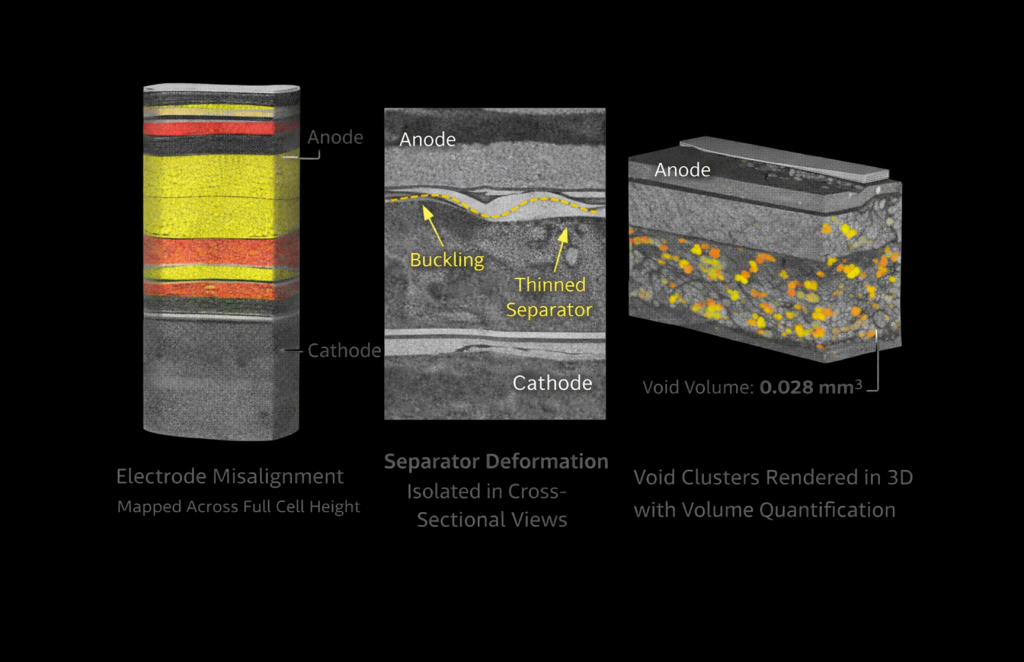
Electrode misalignment mapped across full cell height, Separator deformation isolated in cross-sectional views, Void clusters rendered in 3D with volume quantification
These visuals support both engineering root-cause analysis and process optimization.
Frequently Asked Questions
Can CT detect defects that do not yet affect electrical performance?
Yes. CT reveals structural and alignment defects long before electrical symptoms appear.
Is CT inspection suitable for production environments?
CT is commonly used for sampling, validation, and failure analysis, and increasingly for inline or near-line inspection of critical cells.
Can Xray-Lab quantify defect severity?
Yes. We provide measurable parameters such as misalignment offset, void volume, and separator deformation extent.
Does Xray-Lab inspect full cells or components only?
We inspect full cylindrical, pouch, and prismatic cells, as well as individual internal components.
Conclusion
Lithium-ion battery failures often begin with defects no one can see—until it’s too late. Xray-Lab’s CT-based inspection reveals latent internal risks by analyzing electrode alignment, separator integrity, and void formation in full 3D detail.
By detecting these defects early, manufacturers gain the insight needed to improve safety, reliability, and long-term performance in high-risk battery applications.
